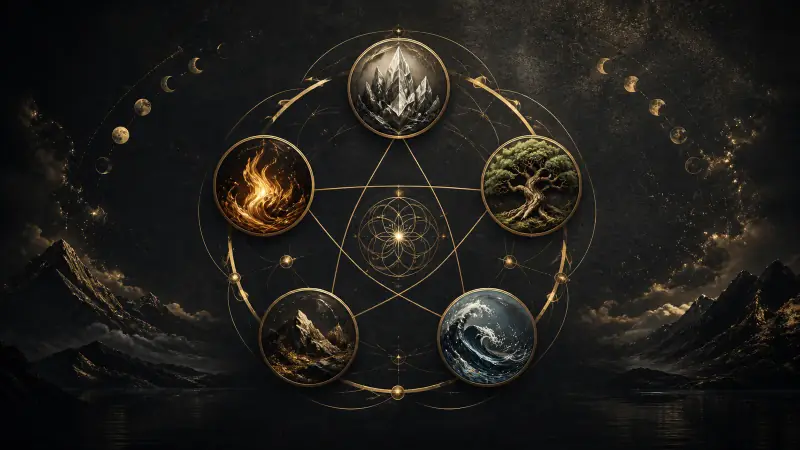
Wood → Fire → Earth → Metal → Water → Wood (continuous cycle)
Excessive Control (Kàng Chéng)
"Kàng" refers to one element being excessively strong, while "Chéng" means to take advantage of weakness, where the strong overpower the weak.
For example, if Wood is too strong and Earth is too weak, Wood's control over Earth becomes excessive. This is known as "Wood Cheng Earth." In the human body, this might manifest as excessive Liver Qi potentially leading to Spleen and Stomach issues.
Reverse Control (Fǎn Wǔ)
"Fǎn Wǔ" refers to the controlled party retaliating and, in turn, controlling the element that originally controlled it.
For example, under normal circumstances, Metal controls Wood. However, if Wood is extremely strong and Metal is extremely weak, a phenomenon called "Wood Wu Metal" can occur. This reverse control relationship deviates from the normal Wuxing cycle.
Common "Fǎn Wǔ" situations:
- Strong Earth, Weak Wood → Wood is counter-controlled by Earth
- Strong Wood, Weak Metal → Metal is counter-controlled by Wood
- Weak Water, Strong Fire → Water is counter-controlled by Fire
- Weak Earth, Strong Water → Earth is counter-controlled by Water
- Strong Metal, Weak Fire → Fire is counter-controlled by Metal
Wuxing and Colors, Directions, Seasons
Wuxing has corresponding relationships with various natural phenomena. This system of correspondences is widely applied in fields such as Feng Shui, health preservation, and auspicious date selection.
Complete Wuxing Correspondence Table
| Wuxing | Color | Direction | Season | Heavenly Stems | Earthly Branches | Numbers |
|---|---|---|---|---|---|---|
| Wood | Green, Azure | East | Spring | Jia, Yi | Yin, Mao | 3, 8 |
| Fire | Red, Scarlet, Purple | South | Summer | Bing, Ding | Si, Wu | 2, 7 |
| Earth | Yellow, Brown | Center | Late Summer (Long Summer) | Wu, Ji | Chen, Xu, Chou, Wei | 5, 10 |
| Metal | White, Silver, Gold | West | Autumn | Geng, Xin | Shen, You | 4, 9 |
| Water | Black, Blue | North | Winter | Ren, Gui | Zi, Hai | 1, 6 |
Wuxing and Chinese Zodiac
| Wuxing | Corresponding Zodiac Animals |
|---|---|
| Wood | Tiger, Rabbit |
| Fire | Snake, Horse |
| Earth | Dragon, Dog, Ox, Goat |
| Metal | Monkey, Rooster |
| Water | Rat, Pig |
Wuxing and Time Periods
According to Wuxing correspondences, different hours of the day also have Wuxing attributes:
- Yin-Mao hours (3-7 AM): Associated with Wood, when the sun rises.
- Si-Wu hours (9 AM-1 PM): Associated with Fire, when the sun is at its highest and hottest.
- Shen-You hours (3-7 PM): Associated with Metal, as the sun sets.
- Hai-Zi hours (9 PM-1 AM): Associated with Water, representing the long night.
- Chen-Xu-Chou-Wei hours: Associated with Earth, occurring at the transitions between seasons.
Wuxing and Human Health
Traditional Chinese Medicine (TCM) theory holds that the body's five zang organs and six fu organs are closely related to the Wuxing. Understanding this correspondence can help in comprehending the body's operational patterns.
Five Zang Organs and Wuxing
| Wuxing | Five Zang Organs | Six Fu Organs | Sensory Organ | Body Tissue |
|---|---|---|---|---|
| Wood | Liver | Gallbladder | Eyes | Tendons |
| Fire | Heart | Small Intestine | Tongue | Blood Vessels |
| Earth | Spleen | Stomach | Mouth, Lips | Muscles |
| Metal | Lungs | Large Intestine | Nose | Skin & Hair |
| Water | Kidneys | Bladder | Ears | Bones |
Inter-promotion and Inter-restraint of the Five Zang Organs
The relationships between the five zang organs follow the Wuxing cycles of promotion and restraint:
Five Zang Inter-promotion:
- Liver Wood promotes Heart Fire: The Liver stores blood to nourish the Heart.
- Heart Fire promotes Spleen Earth: Heart Yang warms the Spleen and Stomach.
- Spleen Earth promotes Lung Metal: The Spleen transforms and transports nutrients to nourish the Lungs.
- Lung Metal promotes Kidney Water: The Lungs govern descent to assist the Kidneys.
- Kidney Water promotes Liver Wood: The Kidneys store essence to nourish the Liver.
Five Zang Inter-restraint:
- Liver Wood restrains Spleen Earth: Excessive Liver Qi can affect the Spleen.
- Spleen Earth restrains Kidney Water: Spleen dampness can impede the Kidneys.
- Kidney Water restrains Heart Fire: Kidney Water rises to control Heart Fire.
- Heart Fire restrains Lung Metal: Ascendant Heart Fire can affect the Lungs.
- Lung Metal restrains Liver Wood: Lung Qi's descending action controls the Liver.
Five-Color Food for Health Preservation
According to Wuxing theory, foods of different colors are believed to nourish their corresponding zang organs:
| Five Colors | Wuxing | Nurtures Zang Organs | Representative Foods |
|---|---|---|---|
| Green/Azure | Wood | Liver | Spinach, Broccoli, Kiwi, Green Bell Pepper |
| Red/Scarlet | Fire | Heart | Red Dates, Goji Berries, Tomatoes, Carrots |
| Yellow | Earth | Spleen | Pumpkin, Corn, Banana, Sweet Potato |
| White | Metal | Lungs | White Radish, Lotus Root, Lily Bulb, Pear |
| Black | Water | Kidneys | Black Beans, Black Fungus, Kelp, Black Sesame |
Wuxing Body Constitution Conditioning Suggestions
Wood Type (Liver & Gallbladder System):
- Focus: Promote the smooth flow of Liver Qi and stabilize emotions.
- Exercise: Stretching, yoga, Tai Chi, outdoor walks.
- Diet: Dark leafy green vegetables, lemon, hawthorn.
- Considerations: Avoid staying up late, suppressing emotions.
Fire Type (Heart System):
- Focus: Calm Heart Fire and soothe the spirit.
- Exercise: Swimming, quiet meditation.
- Diet: Mung beans, winter melon, lotus seeds, asparagus.
- Considerations: Avoid excessive excitement, spicy and stimulating foods.
Earth Type (Spleen & Stomach System):
- Focus: Strengthen the Spleen and Stomach, and resolve dampness and phlegm.
- Exercise: Walking, Baduanjin.
- Diet: Yam, Job's tears, red dates, brown rice.
- Considerations: Avoid cold and raw foods, excessive sweets.
Metal Type (Lung System):
- Focus: Strengthen lung function and support respiratory health.
- Exercise: Deep breathing, brisk walking, swimming.
- Diet: White radish, almond, pear, tremella mushroom.
- Considerations: Avoid spicy and fried foods, maintain fresh air.
Water Type (Kidney System):
- Focus: Warm Kidney Yang and help manage water retention.
- Exercise: Gentle aerobic exercise, avoid overexertion.
- Diet: Black beans, walnuts, goji berries, longan.
- Considerations: Avoid excessive salt, stay warm.
The Five Elements and Personality Traits
In Bazi (Four Pillars of Destiny) analysis, the strength or weakness of the Five Elements can influence an individual's personality traits. Ancient wisdom correlated the Five Elements with five virtues:
| Element | Virtue | Strengths | Potential Challenges |
|---|---|---|---|
| Wood | Benevolence | Kind, righteous, opinionated, generous, helpful | Overly stubborn, impulsive, uncooperative |
| Fire | Propriety | Enthusiastic, outgoing, humble, polite, eloquent | Impulsive, impatient, emotional |
| Earth | Trustworthiness | Honest, reliable, steady, tolerant, magnanimous | Opinionated, slow to react, inflexible |
| Metal | Righteousness | Loyal, resolute, firm, upright, honorable | Too rigid, brave but reckless, not adaptable |
| Water | Wisdom | Intelligent, resourceful, thoughtful, adaptable | Overly cautious, indecisive, calculating |
Detailed Exploration of Five Element Personalities
Characteristics of the Wood Element Personality:
In the Five Elements, Wood embodies "Benevolence," characterized by straightforwardness and harmony. Individuals with strong Wood energy often possess a broad sense of compassion, righteousness, and generosity. They tend to be opinionated, rational, and enjoy helping others. However, an excess of Wood energy might lead to tendencies toward stubbornness, overconfidence, and difficulty in considering other perspectives.
Characteristics of the Fire Element Personality:
Fire in the Five Elements represents "Propriety," marked by a quick temperament and respectful demeanor. Those with strong Fire energy often appear vibrant, humble, polite, and genuinely enthusiastic. They are typically intelligent, articulate, and possess a flair for creativity and expression. Yet, an excess of Fire energy could manifest as impulsiveness, hastiness, and difficulty in maintaining calm reflection.
Characteristics of the Earth Element Personality:
Earth in the Five Elements signifies "Trustworthiness," embodying sincerity and commitment. Individuals with strong Earth energy tend to be magnanimous in their dealings, grateful, and would rather take a loss than exploit others. They are generally reliable, though they might sometimes exhibit stubbornness and a lack of adaptability.
Characteristics of the Metal Element Personality:
Metal in the Five Elements represents "Righteousness," characterized by a firm nature and strong emotions. Those with strong Metal energy are often loyal, resolute, decisive, and generous in supporting justice. They are typically upright, value their reputation, and see tasks through to completion. However, an excess of Metal energy might lead to self-righteousness and an overly assertive or dogmatic approach.
Characteristics of the Water Element Personality:
Water in the Five Elements embodies "Wisdom," signifying resourcefulness and a keen intellect. Individuals with strong Water energy are often thoughtful, strategic planners, and avoid impulsive actions. They are observant and may have an intuitive grasp of trends. Nevertheless, an excess of Water energy could potentially lead to overthinking, indecisiveness, or an overly calculating nature.
Five Element Balance in Bazi
In Bazi analysis, the balance of the Five Elements is often considered to influence an individual's life path and experiences.
What is Five Element Balance?
An ideal Bazi chart is often seen as one where all Five Elements are present, and their energies are relatively balanced, without significant excesses or deficiencies. A balanced Five Element configuration is thought to support harmonious development across various life areas, such as career, well-being, relationships, and finances.
Implications of Five Element Imbalance
- Excess in an Element: An overly strong energy in one element might potentially overshadow other elements, possibly leading to challenges in related areas of life.
- Deficiency in an Element: Insufficient energy in an element might mean its associated functions are not fully expressed.
- Missing Element: The complete absence of a particular element in a Bazi chart is often considered to suggest areas where supportive adjustments might be beneficial.
Approaches to Balancing the Five Elements
A key principle for balancing the Five Elements is to consider whether the element in question is considered favorable or unfavorable in one's Bazi chart. If a missing or weak element is deemed favorable (a "helpful god" or "Favorable and Unfavorable Elements"), then strengthening it might be beneficial. However, if it is considered unfavorable (a "taboo god" or "Unfavorable Element"), then moderation in strengthening it is often advised.
Directional Adjustments:
- For Wood: Spending more time in eastern directions.
- For Fire: Spending more time in southern directions.
- For Earth: Maintaining a central position or focus.
- For Metal: Spending more time in western directions.
- For Water: Spending more time in northern directions.
Color Adjustments:
- For Wood: Incorporating more green and cyan colors.
- For Fire: Incorporating more red and purple colors.
- For Earth: Incorporating more yellow and brown colors.
- For Metal: Incorporating more white, silver, and gold colors.
- For Water: Incorporating more black and blue colors.
Dietary Adjustments:
- For Wood: Consuming more green vegetables and fruits.
- For Fire: Consuming more red foods, such as red dates and goji berries.
- For Earth: Consuming more yellow root vegetables, such as sweet potatoes and pumpkins.
- For Metal: Consuming more white foods, such as white radishes and lotus root.
- For Water: Consuming more black foods, such as black beans and black fungus.
Career Considerations:
- For Wood: Fields like education, publishing, horticulture, and timber.
- For Fire: Fields like electronics, energy, catering, and entertainment.
- For Earth: Fields like real estate, construction, agriculture, and land-related industries.
- For Metal: Fields like finance, metalworking, machinery, and jewelry.
- For Water: Fields like aquaculture, shipping, tourism, and media.
Conclusion: The Five Elements as a Path to Self-Understanding
Although the Five Element theory originated thousands of years ago, the wisdom of balance it embodies continues to offer profound insights.
Understanding the Five Elements can not only help you recognize your personality strengths and potential areas for growth but also offer guidance for making more informed choices in various aspects of life—whether it's for personal well-being, career planning, or navigating relationships.
Remember, the core of the Five Elements lies in "balance." Neither excess nor deficiency is considered optimal; only through a harmonious interplay of generation and control, with smooth circulation, can a state of well-being and completeness be explored.