Complete Beginner's Guide to the I Ching: Basics of the Eight Trigrams and Sixty-Four Hexagrams
The I Ching is one of the most ancient and profound classics in Chinese culture, honored as "the foremost among all classics and the source of the Great Way." Whether you're drawn to Eastern philosophy or curious about ancient wisdom for reflection, this introductory guide will walk you through the core concepts of the I Ching and open the door to this millennia-old text.
What Is the I Ching?
The I Ching, also known as the Book of Changes, is China's oldest philosophical classic. Through a unique symbolic system of sixty-four hexagrams, it explores the patterns and principles of change that govern all things in the universe.
The character "Yi" (Change) itself carries deep meaning, primarily in three layers:
- Change: Everything in the world constantly transforms; this is the fundamental law of the universe.
- Simplicity: Beneath endless change lie simple patterns that can be discerned.
- Permanence: Amid all change, there are unchanging truths.
The value of the I Ching lies not in fortune-telling but in the life wisdom it contains. As the ancients said, "Those who truly understand the I do not resort to divination." Someone deeply versed in the I Ching can perceive the rhythms of change and naturally navigate life with greater discernment. The I Ching, here and elsewhere, is best approached as a tool for self-reflection, helping you organize questions and gain fresh perspectives, rather than as a method for predicting fixed outcomes.
Historical Origins of the I Ching
The I Ching took shape over a long period. Tradition holds that three sages made the greatest contributions — a development known as "the three sages revised the I," spanning "three sages across three ancient eras."
Fu Xi: Creator of the Eight Trigrams
Legend says that in remote antiquity, Fu Xi observed the transformations of heaven and earth. Gazing upward at celestial patterns and downward at terrestrial forms, he created the original eight trigrams. The Han dynasty historian Sima Qian recorded in the Records of the Grand Historian: "Fu Xi, in his supreme sincerity, created the eight trigrams of the Yi."
Fu Xi's trigrams arose from profound observation of nature. Noticing that all things in the world exist in paired contrasts, he used simple symbols to represent these complementary opposites. An unbroken horizontal line "—" stands for yang, while a broken line "--" represents yin. Combining three lines produces the eight trigrams.
King Wen of Zhou: Expander into the Sixty-Four Hexagrams
Toward the end of the Shang dynasty, King Wen of Zhou was imprisoned by the tyrant King Zhou for seven years in Youli. During that long confinement, instead of surrendering to despair, he devoted himself to studying the eight trigrams left by Fu Xi. He overlapped them in pairs to derive the sixty-four hexagrams and composed a judgment text for each hexagram.
The Records of the Grand Historian notes: "King Wen was imprisoned and then elaborated the Zhou Yi." This period of hardship gave rise to the timeless classic. King Wen's son, the Duke of Zhou, is traditionally credited with writing the line statements.
Confucius: Author of the Commentaries
During the late Spring and Autumn period, Confucius developed a deep interest in the I Ching. It is said that he "studied the Yi so intensely that the leather thongs binding the bamboo slips broke three times." Confucius and his disciples composed the Yi Zhuan (Commentaries on the I), also called the "Ten Wings." These include ten treatises such as the Tuan Zhuan, Xiang Zhuan, Xici Zhuan, Wenyan Zhuan, Xugua Zhuan, Shuogua Zhuan, and Zagua Zhuan.
The appearance of the commentaries transformed the Zhou Yi from a mere divination manual into a work exploring life philosophy and ethical cultivation, greatly enhancing its cultural and intellectual depth.
Modern Scholarly Perspectives
Based on archaeological discoveries and textual comparison, contemporary scholars suggest the I Ching was more likely the product of collective authorship. Analysis of the I Ching manuscript unearthed at Mawangdui in Changsha suggests the present version was compiled around the late Western Zhou period, roughly the end of the ninth century BCE. In any case, the profound contributions of Fu Xi, King Wen, and Confucius remain beyond dispute.
Yin, Yang, and Taiji
To understand the I Ching, one must first grasp the concepts of yin and yang and Taiji, the philosophical foundation of the entire classic.
Taiji: The Origin of All Things
The term "Taiji" comes from the Xici Zhuan: "In the Yi there is Taiji, which gives rise to the Two Modes. The Two Modes give rise to the Four Images, and the Four Images give rise to the Eight Trigrams."
"Tai" means ultimate or supreme; "Ji" denotes an endpoint or limit. Taiji refers to the primordial state before the differentiation of all things in the universe — a chaotic, unified source of energy. The Northern Song thinker Zhou Dunyi explained in his Taiji Tu Shuo: "Taiji moves and engenders yang; when movement reaches its limit, there is stillness. Stillness engenders yin; when stillness reaches its limit, there is a return to movement. Movement and stillness each are the root of the other."
Taiji is not static but a state of perpetual motion where "movement contains stillness and stillness contains movement." From Taiji arise yin and yang; from yin and yang, the Four Images and the Eight Trigrams unfold. This is the basic Chinese philosophical description of how the universe comes into being.
Yin and Yang: Opposition and Unity
The I Ching states, "One yin and one yang — this is called the Dao." Yin and yang are the fundamental principles behind all phenomena in the universe.
Yin and yang exhibit four basic conditions:
- Opposition: Yin and yang are opposite forces, like light and dark, movement and stillness, firmness and softness.
- Mutual rooting: Although opposite, yin and yang depend on each other and cannot be separated. As the saying goes, "Solitary yang cannot engender life; solitary yin cannot foster growth."
- Waxing and waning: Yin and yang ebb and flow, maintaining a dynamic balance.
- Mutual transformation: Extreme yin gives birth to yang, and extreme yang gives birth to yin. They can transform into one another.
The Deeper Meaning of the Taiji Diagram
The familiar Taiji diagram (the yin-yang fish symbol) is a visual expression of this philosophy. The black and white halves represent yin and yang, wrapping around each other and containing a seed of the other. The white area contains a black dot, and the black area a white dot, symbolizing that yin always contains yang and yang always contains yin.
This dynamic of mutual waxing, waning, flowing, and generating can be applied to all kinds of life phenomena: positive and negative, high and low, empty and full, movement and stillness, firm and yielding, strong and weak, success and ruin — all can be understood through the lens of yin and yang.
Introduction to the Eight Trigrams
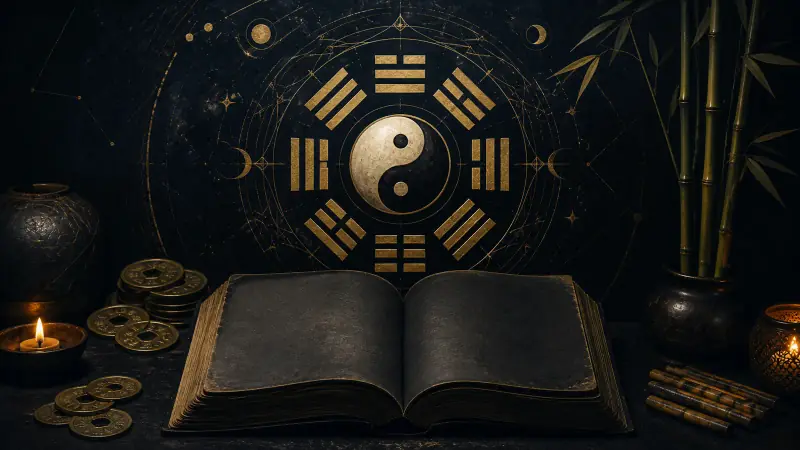
The Eight Trigrams are the basic symbolic units of the I Ching, each composed of three lines that are either yin (broken) or yang (unbroken). Each trigram represents a fundamental natural phenomenon and symbolizes specific qualities and meanings.
The Basic Symbols of the Eight Trigrams
A memory rhyme for the trigrams goes: "Qian is three solid lines, Dui has a broken top, Li is hollow in the middle, Zhen is like an open bowl, Xun has a broken bottom, Kan is full in the middle, Gen is like an upside-down bowl, Kun is six broken lines."
Let's look at each trigram in turn:
Qian ☰ (Heaven)
Qian consists of three yang lines. It symbolizes heaven.
- Natural symbol: Heaven, the sun
- Qualities: Strong, vigorous, creative, active
- Family role: Father
- Direction: Northwest (in Later Heaven arrangement)
- Core spirit: "The movement of heaven is powerful and enduring; thus the noble person constantly strengthens themselves."
Qian represents the purest yang energy, symbolizing unceasing creative power and an ever-moving forward force. Reflecting on Qian can invite awareness of your own initiative, resilience, and capacity to create.
Kun Hexagram ☷ (Earth)
The Kun hexagram consists of three yin lines and symbolizes the earth.
- Natural symbol: Earth, soil
- Qualities associated: Receptivity, embracing, supporting, nurturing
- Family role: Mother
- Direction: Southwest (in Later Heaven Bagua arrangement)
- Core spirit: “The earth’s condition is receptive devotion. Thus the superior man, with his profound virtue, carries all things.”
Kun represents the purest expression of yin receptivity, reflecting the vast, all-embracing capacity of the earth to support and nurture everything.
Zhen Hexagram ☳ (Thunder)
The Zhen hexagram has a yang line at the bottom and two yin lines above, symbolizing thunder.
- Natural symbol: Thunder, earthquake
- Qualities associated: Shaking, awakening, beginning, action
- Family role: Eldest son
- Direction: East (in Later Heaven Bagua arrangement)
- Core spirit: Rising upward with energy, courageous in pioneering.
In ancient understanding, thunder bursts forth from the ground, so the Zhen hexagram can be seen as a shift from stillness to movement, reflecting the power of renewal and breakthrough.
Xun Hexagram ☴ (Wind)
The Xun hexagram has a yin line at the bottom and two yang lines above, symbolizing wind (or wood).
- Natural symbol: Wind, wood
- Qualities associated: Gentle, penetrating, all-pervasive
- Family role: Eldest daughter
- Direction: Southeast (in Later Heaven Bagua arrangement)
- Core spirit: Gentle and humble, yet capable of entering everywhere.
Xun reflects the nature of wind—soft and subtle, yet able to reach every corner—inviting reflection on the wisdom of strength within gentleness.
Kan Hexagram ☵ (Water)
The Kan hexagram has a yang line in the middle, flanked by yin lines above and below, symbolizing water.
- Natural symbol: Water, moon, rain
- Qualities associated: Danger, wisdom, adaptability, depth
- Family role: Middle son
- Direction: North (in Later Heaven Bagua arrangement)
- Core spirit: Facing danger without fear, responding with wisdom and flexibility.
Kan reflects the qualities of water, which can change shape to flow past obstacles, reminding us of the wisdom and resilience needed in difficult times.
Li Hexagram ☲ (Fire)
The Li hexagram has a yin line in the middle, flanked by yang lines above and below, symbolizing fire.
- Natural symbol: Fire, sun, lightning
- Qualities associated: Brightness, warmth, attachment, civilization
- Family role: Middle daughter
- Direction: South (in Later Heaven Bagua arrangement)
- Core spirit: Radiant and upright, flourishing civilization.
Li reflects fire and illumination, pointing toward the expression of wisdom, culture, and beauty.
Gen Hexagram ☶ (Mountain)
The Gen hexagram has a yang line at the top and two yin lines below, symbolizing the mountain.
- Natural symbol: Mountain, rock
- Qualities associated: Stillness, steadiness, firmness, stopping
- Family role: Youngest son
- Direction: Northeast (in Later Heaven Bagua arrangement)
- Core spirit: Knowing when to stop, and stopping; as steady as a mountain.
Gen reflects the quality of the mountain, offering a perspective on the wisdom of timely stillness and stability. Recognizing when to pause is an important life lesson.
Dui Hexagram ☱ (Lake)
The Dui hexagram has a yin line at the top and two yang lines below, symbolizing the lake or marsh.
- Natural symbol: Lake, marsh
- Qualities associated: Joy, harmony, exchange, speech
- Family role: Youngest daughter
- Direction: West (in Later Heaven Bagua arrangement)
- Core spirit: Pleasant and joyful in relationships, delighting in communication.
Dui reflects the nourishing and joyful quality of a lake, inviting reflection on harmony and happiness in human interaction.
The Opposing Palace Relationships
Among the eight trigrams, there are four pairs of opposite trigrams, called “Opposing Palace Hexagrams”:
- Qian and Kun: Heaven and earth oppose each other, representing the fundamental polarity of yin and yang.
- Li and Kan: Fire and water oppose each other, associated with brightness and danger.
- Zhen and Xun: Thunder and wind oppose each other, reflecting movement and penetration.
- Gen and Dui: Mountain and lake oppose each other—“mountain and lake exchange breath”—representing stillness and communication.
The Concept of the 64 Hexagrams
The 64 hexagrams are formed by stacking two of the eight trigrams, one on top of the other. Each hexagram comprises six lines, allowing for a richer expression of situations and transformations.
Structure of the 64 Hexagrams
Each hexagram is divided into an upper trigram (outer trigram) and a lower trigram (inner trigram), each made of three lines. For example:
- Upper trigram Qian, lower trigram also Qian, forming the Qian Hexagram (pure yang).
- Upper trigram Kun, lower trigram also Kun, forming the Kun Hexagram (pure yin).
- Upper trigram Kan, lower trigram Li, forming the Jiji Hexagram (Already Fulfilled).
Since 8 × 8 = 64, there are 64 possible combinations.
Meaning Within the 64 Hexagrams
The I Ching suggests that the 64 hexagrams can reflect 64 fundamental situations a person may encounter in life. Each hexagram contains:
- Hexagram name: Such as Qian, Kun, Zhun, Meng, etc.
- Hexagram statement (Gua Ci): A general interpretation of the entire hexagram.
- Line statements (Yao Ci): Specific interpretation for each line (six lines, giving 384 possible variations).
Examples of Important Hexagrams
Here are a few commonly studied and significant hexagrams:
Qian Hexagram (The Creative, pure yang)
Represents dynamic, proactive energy. Its core spirit is “yuan heng li zhen” (originating, penetrating, beneficial, correct and firm), suggesting the potential for fundamental, far-reaching, beneficial, and principled action.
Kun Hexagram (The Receptive, pure yin)
Represents receptive, carrying capacity. “Profound virtue carries things” points to the quality of embracing all with generosity and strength.
Zhun Hexagram (Difficulty at the Beginning, thunder below, water above)
Represents the hardship of an initial undertaking. It serves as a reminder that beginnings often come with difficulties; staying true to a proper course can help things gradually unfold.
Meng Hexagram (Youthful Folly, mountain above, water below)
Represents the dawning of awareness from inexperience. It encourages an attitude of humble learning when one lacks experience, rather than assuming one already knows.
Xu Hexagram (Waiting, water above, heaven below—clouds)
Represents waiting and the awareness of needs. It teaches patience when the moment has not yet arrived, encouraging trust in the natural unfolding of events.
The Eight-Palace Classification of the 64 Hexagrams
The 64 hexagrams can be grouped into eight palaces, each containing eight hexagrams:
- Qian Palace (8 hexagrams)
- Dui Palace (8 hexagrams)
- Li Palace (8 hexagrams)
- Zhen Palace (8 hexagrams)
- Xun Palace (8 hexagrams)
- Kan Palace (8 hexagrams)
- Gen Palace (8 hexagrams)
- Kun Palace (8 hexagrams)
This classification helps reveal the interrelationships between hexagrams and forms an important foundation for studying the I Ching.
Modern Application of the I Ching
Although the I Ching is an ancient classic, its insights continue to offer valuable perspectives for reflection in contemporary life.
Business Management and Leadership
Management experts around the world are increasingly paying attention to the leadership wisdom within the I Ching. Research from the Business School of The Chinese University of Hong Kong suggests that the hexagrams of the I Ching can offer thought-provoking lenses for modern enterprises:
- Zhun Hexagram (Difficulty at the Beginning): Depicts potential challenges during the start-up phase, inviting entrepreneurs to consider what preparations may be needed.
- Meng Hexagram (Youthful Folly): Raises awareness of how inexperience might sometimes lead to impulsive attitudes.
- Ge Hexagram (Revolution) and Ding Hexagram (The Cauldron): Provide frameworks for reflecting on organizational change, exploring how transformation often naturally involves friction.
- Kan Hexagram (The Abysmal) and Kun Hexagram (Oppression): Offer perspectives on navigating tough times, encouraging a mindset that leaves room for resilience even amid difficulty.
The management philosophy of the I Ching emphasizes a people-oriented outlook, a holistic view, an adaptable approach, and a spirit of harmony—values that many business leaders still find worth reflecting on today.
Decision-Making and Risk Assessment
The core spirit of the I Ching is "change" (Change (I Ching))—different moments present different contexts, different contexts invite different roles, and different roles suggest different possible actions. This way of thinking can help us:
- Analyze our current situation (timing and position)
- Explore possible shifts in circumstances
- Consider potential responses that fit the moment
- Bring greater clarity to decision-making
Personal Cultivation and Psychological Adjustment
The 64 hexagrams of the I Ching cover a wide range of human experiences, including:
- The art of navigating interpersonal relationships
- Approaches to handling difficult moments
- Wisdom for inner adjustment
- Principles for emotional self-management
- Qualities that support effective leadership
The four core spirits of the I Ching from the Western Zhou period—optimism and initiative, commitment to one’s role, relying on oneself rather than external forces, and responsive adaptability—still offer meaningful food for thought for modern psychological well-being.
Everyday Life Applications
Applying the wisdom of the I Ching in daily life can:
- Strengthen one's capacity for thoughtful conduct
- Improve family relationships
- Enhance professional performance
- Help achieve goals through cooperation and mutual understanding
Beginner Suggestions for Studying the I Ching
For those who wish to start learning the I Ching, here are some practical suggestions:
1. Cultivate a Constructive Learning Mindset
The I Ching is not superstition; it is a philosophical system for observing the world and understanding change. Approach it with an open yet discerning mind—neither blindly reverent nor hastily dismissive. As professional I Ching platforms emphasize: "Maintain a spirit of inquiry while holding questions carefully; transmit accurate knowledge without venturing into superstition or sensationalism."
2. Follow a Step-by-Step Learning Sequence
A suggested learning path:
- Begin with Yin-Yang and Taiji: Understand the most fundamental philosophical concepts.
- Memorize the Eight Trigrams (Bagua): Learn the mnemonic phrases and recognize the basic meaning of each trigram.
- Learn the Structure of the 64 Hexagrams: Understand how the hexagrams are composed.
- Practice Divination Methods: Hands-on practice can deepen understanding.
- Read the Original Classic Texts: Eventually return to the classics themselves.
3. Choose Suitable Introductory Books
Experts suggest choosing books that have both academic grounding and the ability to explain ideas in accessible, everyday language. The I Ching series by Professor Fu Peirong is a common starting point for many beginners—the content is considered reliable while remaining clear and easy to follow.
4. Make Good Use of Learning Resources
There are many quality I Ching learning resources available:
- I Ching Learning Websites: Offer free materials and course information.
- I Ching Research Institutes: Provide systematic courses, including unique teaching methods such as image-based interpretation.
- Online Courses: Covering the full 64 hexagrams with structured video lessons.
5. Balance Practice and Personal Insight
The I Ching is a practical body of knowledge. Reading alone is not enough; living it out in daily life matters. You might start with simple hexagram exercises and observe how the patterns resonate with actual situations, gradually cultivating your own understanding of the I Ching's principles.
6. Join a Learning Community
Find like-minded learning partners or join an I Ching study group or class. Mutual exchange and discussion can help clarify doubts and make the learning journey more rewarding.
Conclusion: Starting Your I Ching Journey
As a treasure of Chinese culture, the I Ching has endured for millennia, and its wisdom still offers modern people deep inspiration for reflection. Whether you want to explore Eastern philosophy, seek fresh perspectives on life's questions, or are curious about this ancient art of reflection, the I Ching is well worth getting to know.
As the Great Commentary (Xici) of the I Ching says: "The movement of heaven is full of power; thus the superior person makes themselves strong and untiring. The earth's condition is receptive devotion; thus the superior person carries the outer world with broad inner capacity." These two lines capture the I Ching's core teaching for life—cultivating both dynamic, enterprising spirit and an embracing, generous character.
Learning the I Ching is a long and beautiful journey. From today, take your first step, and let the wisdom of this ancient classic illuminate your path.
The I Ching is a tool for reflection and self-inquiry. The insights shared here are meant to inspire personal contemplation, not to predict outcomes or replace professional advice. For life decisions involving finances, health, legal matters, or mental well-being, please consult qualified professionals.