Ba Zi (Four Pillars) Beginner’s Guide: A Complete Introduction to the Foundations of Life Analysis
Have you ever wondered why some people seem to flow easily through their career, while others keep hitting obstacles in their relationships? Or why two people born on the same day can live such different lives? The answers may lie in the ancient Eastern wisdom of Ba Zi, also known as the Four Pillars of Destiny.
Ba Zi, also called “Four Pillars Astrology” or “Zi Ping Method,” is a system of life analysis that has been passed down for over a thousand years in Chinese culture. By examining the combination of Heavenly Stems and Earthly Branches associated with a person’s birth year, month, day, and hour, it offers a framework for exploring personality traits, life tendencies, career and financial patterns, and relationship dynamics. Whether you’re a curious beginner or someone seeking deeper self-understanding, this introductory guide will walk you through the fundamentals of Ba Zi step by step.
What Is Ba Zi?
As the name suggests, Ba Zi (Bazi) literally means “eight characters.” These eight characters form a symbolic system made up of four pairs of Heavenly Stems and Earthly Branches, each pair corresponding to one of the four time pillars: year, month, day, and hour.
Specifically:
- Year Pillar: Composed of the Heavenly Stem and Earthly Branch for the birth year (e.g., Jia Zi year, Yi Chou year)
- Month Pillar: Composed of the Heavenly Stem and Earthly Branch for the birth month
- Day Pillar: Composed of the Heavenly Stem and Earthly Branch for the birth day
- Hour Pillar: Composed of the Heavenly Stem and Earthly Branch for the birth hour (in traditional two-hour segments)
Each pillar contains one Stem (10 in total) and one Branch (12 in total), making eight characters across the four pillars—hence the name “Ba Zi.” This method is also referred to as “Four Pillars Astrology” or “Four Pillars Destiny Analysis.”
A Ba Zi chart can be seen as a kind of life blueprint, capturing the cosmic energy configuration the moment you were born. By interpreting this chart, we can gain insights into your natural dispositions, personality inclinations, and the types of opportunities and challenges you may encounter at different stages of life.
Historical Origins of Ba Zi
The development of Ba Zi stretches back over a thousand years to the Tang Dynasty.
Li Xuzhong: The Pioneer of Three-Pillar Analysis
The foundational pioneer of Ba Zi is widely acknowledged to be Li Xuzhong (762–813 AD) of the Tang Dynasty. A native of Daming in Hebei who served as an imperial censor, Li Xuzhong transformed a person’s birth year, month, and day into Heavenly Stem and Earthly Branch notations and integrated the Five Elements theory. He assessed a person’s fortune and misfortune through the relationships of generation and control among the Stems and Branches.
The great Tang literatus Han Yu held Li Xuzhong in high esteem, writing in his epitaph that he “judged a person’s lifespan, social standing, and fate with an accuracy that rarely missed one or two cases in a hundred.” At that time, however, Li Xuzhong only used the three pillars of year, month, and day—so in strict terms it was a “six-character” system.
Xu Ziping: The Refiner of Four-Pillar Astrology
During the transition from the Five Dynasties to the early Song period, a reclusive scholar named Xu Ziping (birth name Ju Yi) made revolutionary improvements to Li Xuzhong’s work. Xu lived in seclusion in Tangfeng Cave west of Mount Hua, dedicating himself to the study of destiny analysis.
Xu Ziping’s greatest contribution was adding the Hour Pillar to the existing three pillars, making the system more complete and precise. He also established the principle of using the Day Stem as the representation of the self and developed a systematic method for analyzing the Ten Gods (Shi Shen).
To honor his significant contributions, the later generations named this system “Zi Ping Method” or “Zi Ping Astrology.” In the Southern Song Dynasty, Xu Dasheng compiled Xu Ziping’s teachings into the famous classic Yuan Hai Zi Ping, a work that remains a vital textbook for Ba Zi study today.
Development During the Ming and Qing Dynasties
Ba Zi reached its peak of development during the Ming and Qing dynasties, when many important texts were written, including:
- Di Tian Sui (The Dripping Heaven’s Marrow): often regarded as the pinnacle of Ba Zi theory
- Zi Ping Zhen Quan (True Interpretation of Zi Ping): details the principles of chart structures and useful gods
- San Ming Tong Hui (Comprehensive Compilation of the Three Destinies): a grand encyclopedic synthesis
- Qiong Tong Bao Jian (Treasured Mirror for Penetrating the Mysteries): a classic focused on the Five Elements adjustments (climate regulation)
These works laid a solid theoretical foundation and transformed Ba Zi into a systematic, transmissible body of knowledge.
Basic Concepts of Ba Zi: The Four Pillars in Detail
To learn Ba Zi, you first need to understand what each pillar represents. The four pillars not only mark the moment of birth but also symbolize different phases and aspects of a person’s life journey.
Year Pillar: Roots and Ancestral Foundation
The Year Pillar represents a person’s “roots,” symbolizing ancestry, family heritage, and social background. In life stages, it governs childhood, from birth to about age 16.
The Stem and Branch of the Year Pillar can offer reflections on:
- Family prosperity or decline and social context
- Childhood living environment
- Connections with grandparents
- Inborn foundation of blessings
Traditionally, a well-balanced Five Element configuration in the Year Pillar is thought to indicate a relatively comfortable family environment and a smoother childhood.
Month Pillar: Growth and Parents
The Month Pillar represents the “sprout,” symbolizing parents, siblings, and development during youth. It governs the young adult stage, roughly 16 to 32 years old—a key period for learning, growth, and building foundations.
The Month Pillar holds special importance because its Earthly Branch, known as the “Month Branch” or “Ti Gang” (outline), is the primary reference for determining the chart’s structural pattern. A person’s chart quality, favorable and unfavorable elements (Yong Shen and Ji Shen), largely depend on the strength and configuration of the Month Branch.
The Month Pillar can shed light on:
- Relationships and affinities with parents
- Academic and career development during youth
- Support or hindrance from siblings
- Fundamental personality tendencies
Day Pillar: Self and Spouse
The Day Pillar represents the “flower” and is the core of the chart, because its Heavenly Stem—the Day Stem—is the self, representing “me.”
The Day Pillar governs the middle years, roughly 32 to 48, the prime time for career building, marriage, and family establishment. The Earthly Branch of the Day Pillar (Day Branch) relates to the spouse and marital situation.
Through the Day Pillar, one can explore:
- Core personality, values, and self-identity
- General tendencies in partnership and marriage
- Overall direction during midlife
- Innate physical constitution
Please note: The Day Pillar’s reference to physical constitution is a traditional perspective for self-reflection and should not be taken as a medical diagnosis. If you have health concerns, always consult a qualified healthcare professional.
Hour Pillar: Fruits and Later Life
The Hour Pillar: Fruits and Children
The Hour Pillar symbolizes the "fruit," representing children, students, younger generations, and one’s later years in life. It governs the phase after age 48, a period of harvest and legacy.
The Hour Pillar may offer insights into:
- Connections with children and their development
- Well-being and blessings in later years
- The ultimate achievements of one’s career
- The final chapter of a life path and its sense of completion
An old saying goes: “The pillars of Year, Month, Day, and Hour must all be given equal weight, yet the Hour pillar holds a special importance.” This is because the Hour Pillar is associated with life’s final outcome. Indications about whether one’s later years might be comfortable and whether the younger generation will be close and supportive can often be glimpsed through the Hour Pillar.
An Introduction to Heavenly Stems and Earthly Branches
The Heavenly Stems and Earthly Branches, often called simply the “Stems and Branches,” form the basic symbolic system of Bazi analysis. To read a Bazi chart, you first need to become familiar with these twenty-two characters.
The Ten Heavenly Stems
There are ten Heavenly Stems, listed in order:
Jia (Jia (Yang Wood)), Yi (Yi (Yin Wood)), Bing (Bing (Yang Fire)), Ding (Ding (Yin Fire)), Wu (Wu (Yang Earth)), Ji (Ji (Yin Earth)), Geng (Geng (Yang Metal)), Xin (Xin (Yin Metal)), Ren (Ren (Yang Water)), Gui (Gui (Yin Water))
The ten Stems can be divided into two groups based on their yin-yang nature:
- Yang Stems: Jia, Bing, Wu, Geng, Ren (odd-numbered positions)
- Yin Stems: Yi, Ding, Ji, Xin, Gui (even-numbered positions)
Each Stem also corresponds to one of the Five Elements:
- Jia, Yi → Wood
- Bing, Ding → Fire
- Wu, Ji → Earth
- Geng, Xin → Metal
- Ren, Gui → Water
Among these, Jia is Yang Wood (like a majestic, tall tree) while Yi is Yin Wood (like delicate flowers or vines); Bing is Yang Fire (like the blazing sun) and Ding is Yin Fire (like the gentle glow of a candle). Within each element, the yin and yang expressions carry different qualities.
The Twelve Earthly Branches
There are twelve Earthly Branches, listed in order:
Zi (Zi (Rat)), Chou (Chou (Ox)), Yin (Yin (Tiger)), Mao (Mao (Rabbit)), Chen (Chen (Dragon)), Si (Si (Snake)), Wu (Wu (Horse)), Wei (Wei (Goat)), Shen (Shen (Monkey)), You (You (Rooster)), Xu (Xu (Dog)), Hai (Hai (Pig))
The twelve Branches correspond directly to the twelve Chinese zodiac animals:
- Zi → Rat
- Chou → Ox
- Yin → Tiger
- Mao → Rabbit
- Chen → Dragon
- Si → Snake
- Wu → Horse
- Wei → Goat
- Shen → Monkey
- You → Rooster
- Xu → Dog
- Hai → Pig
The Five Element associations of the Earthly Branches are:
- Yin, Mao → Wood
- Si, Wu → Fire
- Shen, You → Metal
- Hai, Zi → Water
- Chen, Xu, Chou, Wei → Earth
The Sexagenary Cycle
The ten Heavenly Stems and twelve Earthly Branches are paired in sequence, forming sixty basic units known as the “sixty Jia Zi.” This cycle continuously repeats and is used to mark years, months, days, and hours.
For example, 2024 is the Jia Chen year (Jia being the Heavenly Stem, Chen the Earthly Branch), 2025 will be Yi Si, and so on. Sixty years make one full cycle, which is why reaching sixty is traditionally called “completing one Jia Zi.”
The Basics of the Five Element Cycles
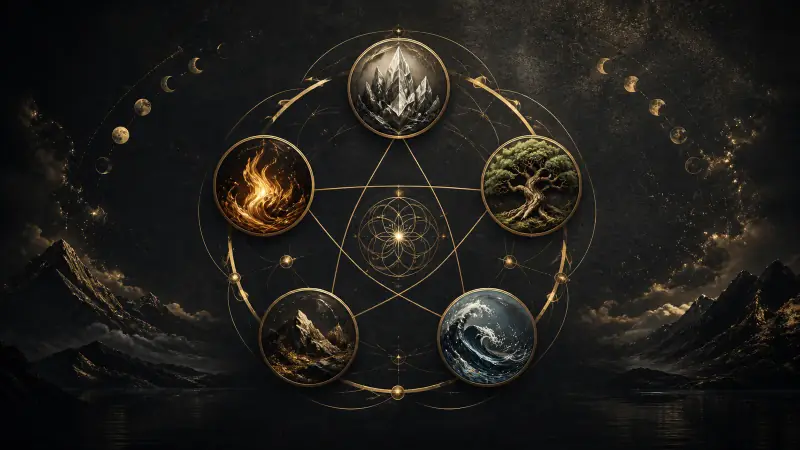
The Five Element theory is the philosophical core of Bazi interpretation. The generating (sheng) and overcoming (ke) relationships among Metal, Wood, Water, Fire, and Earth form the framework for understanding the dynamic patterns in a birth chart.
The Generating Cycle (Xiang Sheng)
Generation refers to how one element nurtures and supports another:
- Wood generates Fire: Wood burns to create fire.
- Fire generates Earth: After burning, fire leaves ash that returns to the earth.
- Earth generates Metal: Metal ores are mined from within the earth.
- Metal generates Water: Metal surfaces can collect condensation, giving rise to water.
- Water generates Wood: Water nourishes the growth of trees.
A simple mnemonic: Wood, Fire, Earth, Metal, Water – in this order, each gives life to the next.
The Overcoming Cycle (Xiang Ke)
Overcoming refers to how one element restrains or controls another:
- Wood overcomes Earth: Tree roots penetrate and break up the soil.
- Earth overcomes Water: Earth can build dams to hold back water.
- Water overcomes Fire: Water can extinguish fire.
- Fire overcomes Metal: Fire can melt and reshape metal.
- Metal overcomes Wood: Metal tools like axes cut down trees.
A mnemonic to remember: Wood, Earth, Water, Fire, Metal – skip one step to find what each overcomes.
Applying the Five Elements in Bazi
In Bazi analysis, the balance and smooth flow of the Five Elements are considered very significant. A harmonious chart is often described as showing:
- Complete elements: All five—Metal, Wood, Water, Fire, Earth—are present, without major gaps.
- Smooth interaction: The elements support one another in a flowing sequence.
- Balance: No single element is excessively strong or noticeably weak.
If a particular element appears overly dominant or very deficient in a chart, the concept of a Useful God (Yong Shen) comes in—an element or combination that can help restore balance. This is one of the central techniques in traditional Bazi interpretation.
An Introduction to the Ten Gods
The Ten Gods are a vital analytical tool in Bazi. They centre everything on the Day Stem (the self, or the person represented by the chart) and assign distinct names and symbolic meanings based on the Five Element relationships between the Day Stem and all other Stems and Branches in the chart.
Where the Ten Gods Come From
The Ten Gods are derived as follows:
- What produces me: Direct Resource (Zheng Yin), Indirect Resource (Pian Yin)
- What I produce: Eating God (Shi Shen), Hurting Officer (Shang Guan)
- What controls me: Direct Officer (Zheng Guan), Seven Killings (Qi Sha, also called indirect officer)
- What I control: Direct Wealth (Zheng Cai), Indirect Wealth (Pian Cai)
- What is the same type as me: Friend (Bi Jian), Rob Wealth (Jie Cai)
The distinction between “Direct” and “Indirect” depends on the yin-yang polarity:
- When the interacting pair is of opposite gender (yin meets yang or yang meets yin), it is classed as Direct.
- When the pair is of the same gender (yang meets yang or yin meets yin), it is classed as Indirect.
The Ten Gods in Detail
1. Direct Resource, Indirect Resource (What Produces Me)
Resource stars represent mother, benefactors, education, reputation, protection.
- Direct Resource: Steady and kind-hearted, represents formal education and a good reputation
- Indirect Resource: Also called “Owl God,” intelligent and resourceful but more solitary; represents unconventional knowledge or special talents
2. Direct Officer, Seven Killings (What Controls Me)
Officer stars represent superiors, husband (for women), pressure, responsibility, status.
- Direct Officer: Upright, law-abiding, values reputation; represents legitimate authority and position
- Seven Killings: Also called “Indirect Officer,” possesses pioneering spirit and boldness, but also brings pressure and challenges
3. Direct Wealth, Indirect Wealth (What I Control)
Wealth stars represent money, wife (for men), material enjoyment.
- Direct Wealth: Hardworking and frugal, steady income; represents earnings from proper work
- Indirect Wealth: Generous and open-handed, good at investing; represents unexpected wealth or speculative gains
4. Eating God, Hurting Officer (What I Produce)
The Eating God and Hurting Officer represent talent, creativity, children, expressive ability.
- Eating God: Gentle and optimistic, blessed with happiness; represents a steady expression of talent
- Hurting Officer: Extremely intelligent, rebellious and innovative; represents creative ability that breaks through convention
5. Friend, Rob Wealth (Same as Me)
The Friend and Rob Wealth represent siblings, friends, competitors.
- Friend: Independent and self-reliant, values loyalty; represents healthy competition and cooperation
- Rob Wealth: Proactive and enterprising but competitive; represents rivalry and resource consumption
The Ten Gods and Their Corresponding Relationships
Beyond personality traits, the Ten Gods also correspond to different familial relationships:
| Ten God | Male Six Relations | Female Six Relations |
|---|---|---|
| Direct Resource | Mother | Mother |
| Indirect Resource | Stepmother, adoptive mother | Stepmother, adoptive mother |
| Direct Officer | Daughter, superiors | Husband |
| Seven Killings | Son | Lover, romantic connections |
| Direct Wealth | Wife | Father |
| Indirect Wealth | Father, lover | Mother-in-law |
| Eating God | Son-in-law, granddaughter | Daughter |
| Hurting Officer | Grandmother | Son |
| Friend | Brothers | Sisters |
| Rob Wealth | Sisters | Brothers |
What Can Bazi Reveal?
The ultimate goal of studying Bazi is to “know yourself and navigate life’s path with awareness.” So, what life aspects can Bazi illuminate?
1. Personality Traits and Talents
Each person’s Bazi has a unique arrangement of the Five Elements and Ten Gods, which shape their basic character:
- Strong Wood: Benevolent, upright, proactive
- Strong Fire: Warm-hearted, outgoing, courteous
- Strong Earth: Steady, grounded, trustworthy
- Strong Metal: Decisive, resolute, values loyalty
- Strong Water: Intelligent, flexible, adaptable
Through Bazi, we can discover our innate strengths and potential talents, helping us choose a suitable direction for growth.
2. Career and Wealth
The arrangement of wealth and officer stars in a Bazi chart can reflect a person’s career patterns and wealth tendencies:
- Strong Direct Wealth: may be well-suited for stable salaried work
- Strong Indirect Wealth: may have potential for investment or entrepreneurship
- Strong Officer stars: may be suited for management or public service
- Strong Eating God / Hurting Officer: may thrive in creative, artistic, or technical fields
By analyzing the cycles of Major Luck and Annual Luck, we can gain perspective on which periods might hold greater opportunity for career growth, and when extra caution could be beneficial.
3. Love and Marriage
The Day Branch in a Bazi chart, along with the spouse star (wealth star for men, officer star for women), can offer insights into relationship and marriage patterns:
- If the Day Branch is a favorable god: marriage is often harmonious and fulfilling
- If the spouse star is strong and well-placed: encountering a suitable partner may come more easily
- If Friend/Rob Wealth stars are overly strong: there may be tendencies toward romantic rivalry or third-party situations
Understanding one’s own relationship patterns can help in meeting the right person at the right time.
4. Health and Vitality
The Five Elements have correspondences with body organs:
- Wood → Liver, gallbladder, eyes
- Fire → Heart, small intestine, blood circulation
- Earth → Spleen, stomach, muscles
- Metal → Lungs, large intestine, skin
- Water → Kidneys, bladder, bones
When a particular element is overly strong or weak in a Bazi chart, the corresponding organ systems might be areas to pay extra attention to. This is not a diagnosis, but a perspective akin to preventive awareness—it should never replace professional medical advice. For any health concerns, always consult a qualified healthcare provider.
5. Life Stages and Fluctuations in Fortune
Through analyzing the Major Luck and Annual Luck cycles, we can gain a reflective understanding of the shifting tides over different life stages:
- Major Luck: A ten-year phase, representing the larger environmental changes in life
- Annual Luck: The yearly influence, reflecting that year’s opportunities and challenges
By attuning to these rhythmic patterns, we can more consciously seize opportunities during favorable periods and stay prudent during more challenging times, not to control fate but to navigate with greater awareness.
Approaching Bazi with the Right Mindset
Before concluding this introductory guide, I’d like to share a few helpful attitudes for learning Bazi:
1. Bazi is a reference, not a fixed destiny
A Bazi chart records the inborn conditions at your moment of birth, but life’s unfolding is also shaped by environment, personal effort, education, and countless other factors. Bazi offers a kind of “life map,” showing where there are mountains and rivers—but the path you walk is ultimately up to you.
2. Know and accept yourself
The greatest value of studying Bazi lies in gaining a deeper understanding of yourself. When you become aware of your character strengths and weaknesses, and the directions that might suit you, you can make wiser life choices. Accepting your inherent conditions and then striving to grow from that foundation is the right attitude.
3. Take it step by step, keep learning
Bazi is a profound and vast study, not something to be mastered overnight. I suggest building a solid foundation, reading classical works, and practicing chart interpretation regularly. In time, you will surely gain valuable insights.
Begin Your Journey of Self-Discovery through Bazi
Bazi is a crystallization of Eastern wisdom, carrying millennia of observation and insight from countless sages. Through this introductory guide, I hope you have gained a basic understanding of Bazi.
Your choices shape your path, and insight can help you navigate with greater awareness.
Reference Resources
- [Bazi (Four Pillars of Destiny) – Wikipedia](https://zh.wikipedia.org/wiki/Bazi astrology)
- Bazi Introductory Guide – Kunde Zhi Ming Zao Ming
- Five Elements and Bazi Destiny Introduction – Dao Yuan Ge
- [Comprehensive Bazi Fundamentals Compilation – Yi Jia Feng Shui](https://www.ijfate.com/A comprehensive guide to Bazi (Four Pillars of Destiny) basics./)