Zi Wei Dou Shu Complete Beginner's Guide: Essential Foundations for Interpreting Your Birth Chart
Have you ever wondered about your life's journey? Curious about potential turning points in your career or the types of connections you might form in relationships? Among various metaphysical studies, Zi Wei Dou Shu is often called 'Eastern Astrology.' Its insightful and detailed analysis has helped countless individuals gain a deeper understanding of their life's potential.
This article will guide you through Zi Wei Dou Shu from the ground up, covering its historical origins, the Twelve Palaces, the Fourteen Major Stars, and how to plot and interpret a chart. Step by step, you'll build a solid foundation. Whether you're a metaphysics enthusiast or simply seeking to understand yourself better, this guide can open a door to self-awareness.
What is Zi Wei Dou Shu?
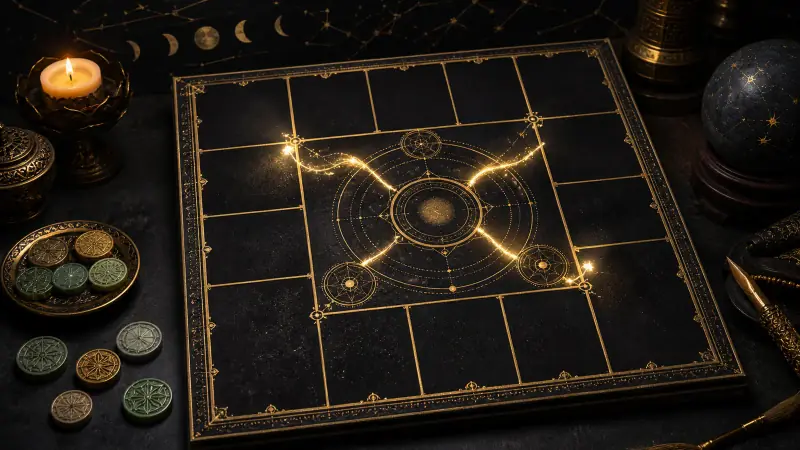
Zi Wei Dou Shu is a form of Chinese ancient metaphysics that analyzes an individual's birth time (Lunar calendar year, month, day, and hour). It places various stars into twelve distinct 'palaces,' forming a unique 'birth chart' (Natal Chart). This chart can be seen as a map of one's life, offering insights into personality traits, inherent talents, life experiences, and potential energetic shifts.
Unlike Western astrology, which uses the twelve zodiac signs, Zi Wei Dou Shu centers around the 'Zi Wei Star.' It integrates traditional Chinese astronomical observations, Yin-Yang and Five Elements theory, and the Heavenly Stems and Earthly Branches to construct a comprehensive system for exploring life's patterns. The Zi Wei Star was historically regarded as the 'Emperor Star,' symbolizing nobility and centrality, which is why this discipline is named 'Zi Wei Dou Shu.'
Why Explore Zi Wei Dou Shu?
Among various metaphysical tools, Zi Wei Dou Shu offers several unique advantages:
| Feature | Description |
|---|---|
| Detailed Analysis | The Twelve Palaces each represent specific life areas, allowing for focused insights into career, relationships, finances, and more. |
| Clear Timeframes | Grand Cycles, Annual Cycles, and Monthly Cycles can be explored, offering perspectives on potential energetic shifts across different life stages. |
| In-depth Personality Portrayal | Combinations of Major and Minor Stars can reveal intricate aspects of one's personality. |
| High Practicality | Can be utilized for self-awareness, career exploration, relationship insights, auspicious timing, and more. |
Exploring Zi Wei Dou Shu is not about fatalistically accepting everything, but rather about gaining insights into your innate characteristics and potential life paths to make more informed choices. As the ancients said: 'One who understands their destiny does not blame heaven; one who understands themselves does not blame others.'
Historical Origins of Zi Wei Dou Shu
Founder: Patriarch Chen Tuan
The founder of Zi Wei Dou Shu is traditionally believed to be Chen Tuan (872-989 CE), a renowned Taoist priest from the Five Dynasties and Northern Song periods. His courtesy name was Tu Nan, and his sobriquet was Master Xi Yi. Later generations respectfully referred to him as 'Patriarch Chen Tuan.'
It is said that during his cultivation on Mount Hua, Chen Tuan developed this system for exploring individual life paths, drawing upon Taoist astronomical observations, the Five Elements theory of generation and overcoming, and the movements of celestial bodies. Another account suggests that Zi Wei Dou Shu was transmitted to Chen Tuan by Lü Dongbin.
Development Trajectory
The predecessors of Zi Wei Dou Shu can be traced back to the 'Qin Tang Five-Star Art' and 'Eighteen Flying Stars' of the Tang Dynasty. According to research from various sources, the prototype of Zi Wei Dou Shu is likely the ancient astrological system 'Seven Luminaries and Four Obscurations,' which was introduced to China from India during the Tang Dynasty by Buddhist monks and Arabs, and subsequently refined and developed by generations of metaphysicians.
Ancient texts on Zi Wei Dou Shu are quite rare. Currently verifiable major classics include 'Complete Collection of Zi Wei Dou Shu,' 'Complete Book of Zi Wei Dou Shu,' and 'Concise Guide to Zi Wei Dou Shu.' Among these, 'Concise Guide to Zi Wei Dou Shu' was compiled in the ninth year of the Wanli reign of the Ming Dynasty (1581), marking the earliest verifiable appearance of the name 'Zi Wei Dou Shu.'
The development of Zi Wei Dou Shu spanned several dynasties, undergoing transmission and evolution. Figures such as Liu Bowen of the Ming Dynasty and Deng Zilong of the Qing Dynasty organized and supplemented Zi Wei Dou Shu, contributing to its evolution into a more comprehensive metaphysical system. As this art was long transmitted secretly in the form of unique manuscripts among disciples and descendants, this is one reason for the scarcity of related literature.
Detailed Explanation of the Twelve Palaces
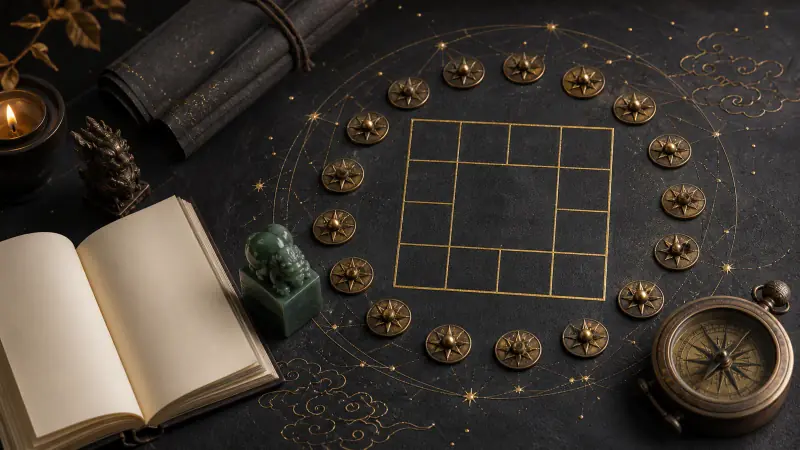
A Zi Wei Dou Shu birth chart (Natal Chart) is composed of twelve palaces, each representing different facets of life. Understanding the significance of each palace is fundamental to interpreting a chart.
Palace Arrangement Order
The arrangement of the Twelve Palaces is fixed, starting from the Life Palace (Life Palace) and proceeding counter-clockwise in sequence:
Life Palace (Life Palace) → Siblings Palace (Siblings Palace) → Spouse Palace (Spouse Palace) → Children Palace (Children Palace) → Wealth Palace (Wealth Palace) → Health Palace (Sickness Palace) → Travel Palace (Travel Palace) → Friends Palace (Friends Palace / Associates Palace) → Career Palace (Career Palace / Career Palace) → Property Palace (Property Palace) → Fortune Palace (Fortune Palace) → Parents Palace (Parents Palace)
Palace Categories
The Twelve Palaces can be divided into two main categories:
Six Kinship Palaces (6): Related to family relationships
- Parents Palace, Siblings Palace, Spouse Palace, Children Palace, Life Palace, Fortune Palace
Six Personal Affairs Palaces (6): Related to personal development
- Wealth Palace, Health Palace, Travel Palace, Friends Palace, Career Palace, Property Palace
Detailed Explanation of Each Palace
1. Life Palace (Most Important)
The Life Palace is the core of the birth chart, and all interpretations are based on it. It offers insights into an individual's innate predispositions and subsequent development, including:
- Personality traits and character
- Appearance and demeanor
- Talents and aptitudes
- Thoughts and spirit
- Life's ups and downs
- First impressions on others
The Life Palace can also reflect the general perception or evaluation one might receive over the course of their life. To understand an individual's potential scope, approach to life, and social standing, the Life Palace serves as a primary point of reflection.
2. Siblings Palace
This palace reflects relationships with siblings, the depth of these connections, and the extent of support from them. It can also extend to interactions with peers, friends, and colleagues.
3. Spouse Palace
This palace offers insights into marital status, characteristics of a spouse, dynamics of a marital relationship, views on love, and the potential harmony of marriage. For those unmarried, this palace can provide reflections on the characteristics of a future partner.
4. Children Palace
This palace reflects connections with children, their personalities and development, parenting styles, and can also offer insights into aspects of one's sex life and fertility.
5. Wealth Palace
This palace indicates earning potential, financial management concepts, financial outlook, suitable ways to earn money, and patterns of wealth accumulation and loss.
6. Health Palace
This palace reflects physical health conditions, predispositions to certain ailments, physical constitution, and the potential for accidents or misfortunes.
7. Travel Palace
This palace offers insights into travel prospects, experiences during journeys, potential for emigration, popularity and development when away from home, and interactions with external environments.
8. Friends Palace (Servants Palace)
This palace reflects interpersonal relationships, friendships, dynamics with subordinates, the nature of business partnerships, and the presence of benefactors and detractors.
9. Career Palace (Official Rank Palace)
This palace indicates career development, suitable career types, work attitude, potential for achievement, and social status and reputation.
10. Property Palace
This palace reflects real estate prospects, living environment, family life, inheritance of ancestral property, and the foundation for one's stability and livelihood.
11. Fortune and Virtue Palace
This palace offers insights into spiritual life, inner world, hobbies and interests, capacity for enjoyment, and prospects for old age and blessings. It serves as an indicator of one's inner sense of well-being.
12. Parents Palace
This palace reflects relationships with parents, their characteristics and health, hereditary influences, and can also indicate interactions with elders and superiors.
Body Palace: The Hidden 13th Palace
Beyond the twelve palaces, Zi Wei Dou Shu also incorporates the concept of the "Body Palace." The Body Palace can be considered a hidden 13th palace, differing from the Life Palace in that:
- Life Palace: Generally reflects the first half of life (approximately before age 35).
- Body Palace: Tends to influence the latter half of life (approximately after age 35).
The position of the Body Palace can indicate the focus of one's life, areas of deep importance, and significant concerns. After middle age, one's personality and life path may gradually align more with the characteristics indicated by the Body Palace.
Introduction to the Fourteen Major Stars
The Fourteen Major Stars of Zi Wei Dou Shu are central to the entire birth chart analysis, also known as 'Grade A Stars'. These fourteen major stars originated from ancient people's natural reverence for celestial bodies, each possessing distinct personality traits and symbolic meanings.
Star System Classification
The Fourteen Major Stars are classified with Zi Wei as the North Dipper Star Lord, Tian Fu as the South Dipper Star Lord, and Tai Yang (Sun) and Tai Yin (Moon) as the Mid-Heaven Star Lords:
Zi Wei Star System (North Dipper): Zi Wei Star, Tian Ji Star, Tai Yang Star, Wu Qu Star, Tian Tong Star, Lian Zhen Star
Tian Fu Star System (South Dipper): Tian Fu Star, Tai Yin Star, Tan Lang Star, Ju Men Star, Tian Xiang Star, Tian Liang Star, Qi Sha Star, Po Jun Star
Detailed Characteristics of Each Main Star
1. Zi Wei Star - The Emperor Star
The Zi Wei Star is considered the leader among all stars, embodying "dignity" (Esteemed). In a Zi Wei Dou Shu birth chart, it often reflects one's spiritual or inner compass.
Positive Qualities: Noble, magnanimous, strong leadership, mature and steady, humble and polite.
Potential Challenges: Arrogant, unwilling to lose, highly subjective, tends to dominate.
Individuals with the Zi Wei Star in their Life Palace may find themselves drawn to leadership roles, often possessing a strong sense of self-respect and a natural inclination towards guiding others. This placement can inspire a focus on developing leadership qualities.
2. Tian Fu Star - The Treasury Star
The Tian Fu Star embodies "command" (Season) and is often seen as a material indicator in Zi Wei Dou Shu, associated with wealth and property.
Positive Qualities: Prudent and decisive, mature and steady, highly perceptive, strong management skills, possesses a commanding presence.
Potential Challenges: Overly conservative, excessive crisis awareness, stubborn.
Individuals with the Tian Fu Star in their Life Palace may find themselves naturally adept at managing finances and often prioritize material security. This placement can inspire a focus on careers in finance or management.
3. Tai Yang Star - The Sun Star
The Tai Yang Star is a central main star, symbolizing nobility, brightness, and universal love, embodying "nobility" (Nobleman).
Positive Qualities: Enthusiastic, proactive, image-conscious, values politeness, enjoys helping others.
Potential Challenges: Prone to overexertion, sensitive about reputation, may become fatigued from giving without seeking reciprocity.
Individuals with the Tai Yang Star in their Life Palace may find themselves possessing an open personality and public charm. This placement can inspire a focus on careers in service, public relations, or politics.
4. Tai Yin Star - The Moon Star
The Tai Yin Star embodies "wealth" (Wealth Element) and "abundance" (Wealth), representing accumulation. It is often associated more with wealth than nobility, and is linked to property and finances.
Positive Qualities: Receptive, sensitive, subtle insight, nurturing, refined taste.
Potential Challenges: Emotional, overly passive, may experience a lack of security.
Individuals with the Tai Yin Star in their Life Palace may find themselves possessing a sensitive and refined nature. This placement can inspire a focus on careers in art, design, or real estate.
5. Wu Qu Star - The Martial Wealth Star
The Wu Qu Star embodies "wealth" (Wealth Element) and is considered one of the primary wealth stars, representing legitimate income and practical endeavors.
Positive Qualities: Resolute and decisive, strong execution, practical, diligent and hardworking.
Potential Challenges: Overly rigid, may struggle to express emotions, stubborn.
Individuals with the Wu Qu Star in their Life Palace may find themselves drawn to careers requiring specialized skills, such as finance, accounting, or engineering. This placement can inspire a focus on practical and skill-based professions.
6. Tian Tong Star - The Blessing Star
The Tian Tong Star is considered the most peaceful among the fourteen main stars, historically known as the "Blessing Star."
Positive Qualities: Approachable, content, magnanimous, forgiving, excellent interpersonal skills.
Potential Challenges: Overly complacent, may lack ambition, prone to relying on others.
Individuals with the Tian Tong Star in their Life Palace may find themselves often receiving support from benefactors and experiencing a comfortable life. This placement can inspire a focus on appreciating ease, while also encouraging mindfulness to avoid excessive indulgence.
7. Lian Zhen Star - The Integrity Star
In ancient texts, the Lian Zhen Star was referred to as the "Killing Star" (Malefic Star) and the "Prisoner Star" (Imprisoned Star). "Killing" can represent an impulsive personality, while "Prisoner" can signify pride or arrogance.
Positive Qualities: Exceptionally talented, artistic flair, strong romantic appeal, charismatic.
Potential Challenges: Arrogant, volatile, unwilling to yield, emotional.
Individuals with the Lian Zhen Star in their Life Palace may find themselves possessing a strong sense of pride and a natural inclination towards creative or impactful fields. This placement can inspire a focus on careers in art, performing arts, or law.
8. Tian Ji Star - The Wisdom Star
The Tian Ji Star is often considered one of the most intelligent stars among the Zi Wei Dou Shu main stars, particularly adept at logical reasoning and deduction.
Positive Qualities: Intelligent, quick-witted, analytical, kind-hearted, highly adaptable.
Potential Challenges: Overthinking, indecisive, nervous.
Individuals with the Tian Ji Star in their Life Palace may find themselves possessing a flexible mind. This placement can inspire a focus on careers in planning, analysis, or consulting, which often require intellectual engagement.
9. Tan Lang Star - The Desire Star
The Tan Lang Star is a versatile star, often associated with strong desires and a pursuit of sensory pleasures.
Positive Qualities: Multi-talented, excellent social skills, charismatic, knows how to enjoy life.
Potential Challenges: Greedy, excessive desires, prone to indulgence.
Individuals with the Tan Lang Star in their Life Palace may find themselves drawn to careers requiring strong social skills, such as sales, entertainment, or hospitality. This placement can inspire a focus on engaging with others and enjoying life's experiences.
10. Ju Men Star - The Eloquence Star
The Ju Men Star embodies "darkness" (Dark), and is often associated with communication, speech, and potential disputes.
Positive Qualities: Eloquent, strong analytical skills, skilled in debate, seeks truth.
Potential Challenges: Suspicious, prone to verbal disputes, may easily get into arguments.
Individuals with the Ju Men Star in their Life Palace may find themselves possessing strong communication skills. This placement can inspire a focus on careers such as law, teaching, hosting, or journalism, which often require articulate expression.
11. Tian Xiang Star - The Seal Star
The Tian Xiang Star embodies "the seal" (Resource Element), representing assistance and service.
Positive Qualities: Gentle, service-oriented, good interpersonal skills, strong coordination abilities.
Potential Challenges: May lack initiative, overly reliant on others, easily influenced.
Individuals with the Tian Xiang Star in their Life Palace may find themselves drawn to supportive roles. This placement can inspire a focus on careers such as secretarial work, administration, or public relations.
12. Tian Liang Star - The Benevolence Star
The Tian Liang Star embodies "shelter" (Ancestral Blessing), representing protection and guardianship.
Positive Qualities: Upright, principled, enjoys helping others, good rapport with elders, may experience turning misfortune into fortune.
Potential Challenges: Preachy, self-righteous, overly interfering.
Individuals with the Tian Liang Star in their Life Palace may find themselves drawn to helping professions. This placement can inspire a focus on careers in healthcare, education, social work, or religious fields.
13. Qi Sha Star - The General Star
The Qi Sha Star is a powerful and assertive star, representing pioneering and striving.
Positive Qualities: Decisive, charismatic, unwilling to lose, strong initiative, courageous in challenges.
Potential Challenges: Impulsive, combative, resistant to discipline, may easily make enemies.
Individuals with the Qi Sha Star in their Life Palace may find themselves possessing a strong drive. This placement can inspire a focus on entrepreneurship, sales, sports, or military/police work, which often require assertiveness and courage.
14. Po Jun Star - The Pioneer Star
The Po Jun Star embodies "consumption" (Expenditure Element), representing change, destruction, and reconstruction.
Positive Qualities: Innovative, unconventional, pioneering spirit, daring and adventurous.
Potential Challenges: Strong tendency towards disruption, restless with the status quo, may experience significant life fluctuations.
Individuals with the Po Jun Star in their Life Palace may find themselves drawn to roles involving innovation, research and development, or reform. This placement can inspire a focus on embracing change and finding excitement in dynamic life experiences.
Determining Your Life Palace Main Star(s)
When any one or two of these 14 stars appear in your Life Palace (Life Palace) on your birth chart, they are referred to as your "Life Palace Main Star(s)":
- Single Star: Only one main star is present.
- Dual Stars: Two main stars are present in the same palace.
- Empty Life Palace: If no main star is present, the main star(s) from the opposite palace (Migration Palace / Travel Palace) are borrowed and considered your Life Palace Main Star(s).
How to Plot Your Birth Chart?
Information Needed for Charting
To create a Zi Wei Dou Shu birth chart, the following basic information is required:
- Name
- Biological sex: The direction of progression (forward/reverse) differs for males and females.
- Lunar calendar birth year, month, day, and time: This is the most crucial information.
Special note: Zi Wei Dou Shu uses the Lunar Calendar (lunisolar calendar), not the Gregorian calendar. If you only know your Gregorian birthday, you'll need to convert it to the Lunar Calendar first.
Importance of Birth Time
Zi Wei Dou Shu requires a precise birth hour. Even a slight difference in birth time can result in a significantly different birth chart. This differs from Bazi (Four Pillars of Destiny), which divides a day into two-hour segments. Zi Wei Dou Shu, however, demands more precise timing.
Zi Wei Dou Shu primarily uses the lunisolar calendar, with a new day beginning at 11 PM (23:00). If you are unsure of your birth hour, you can request your birth certificate from the household registration office to check.
Basic Charting Steps
The standard operating procedure (SOP) for charting is as follows:
- Convert Gregorian birthday to Lunar Calendar
- Determine Yin/Yang and male/female: Based on the Heavenly Stem of the birth year.
- Determine the Heavenly Stem of the Yin Palace using the 'Five Tiger Escapes' method.
- Determine the Life Palace and Body Palace: Using the birth month and birth hour.
- Arrange the 12 Palaces counter-clockwise from the Life Palace.
- Determine the Life Master and Body Master: The Life Master uses the Earth Branch of the Life Palace, and the Body Master uses the Chinese zodiac sign.
- Position the Zi Wei Star Cluster.
The mnemonic for positioning the Zi Wei Star is: "Zi Wei and Tian Ji stars move counter-clockwise, then Yang Wu Tian Tong follow, Tian Tong is two apart from Lian Zhen." Once the Zi Wei Star is positioned, the other stars of the Zi Wei cluster are arranged accordingly.
Online Charting Resources
Today, there's no need to manually chart. You can use free online charting systems:
- Zi Wei Yun Charting System
- Tech Zi Wei Net
- Ling Xia Net Zi Wei Dou Shu Online Charting
- Jian Ling Metaphysics Net Zi Wei Dou Shu Charting
Simply enter your birth information, and the system will automatically generate a complete birth chart. However, beginners are encouraged to understand the basic principles of charting, as this can lead to a deeper understanding during interpretation.
Differences Between Zi Wei Dou Shu and Bazi
Different Fundamental Principles
Zi Wei Dou Shu: Emphasizes "stars," "palaces," and their interactive relationships, highlighting the interplay and influence between various palaces. It can be a valuable tool for gaining insights into personality and the complexities of life's interactions.
Bazi: Focuses on the "Five Elements" interactions (creation, destruction, control, transformation), "Ten Gods patterns," and "useful god adjustments," emphasizing the dynamic interplay between an individual and their environment.
Requirements for Birth Time
Zi Wei Dou Shu: Requires a precise birth hour, as even a slight difference in birth time can result in a significantly different birth chart.
Bazi: Divides a day into two-hour segments. Even without a precise birth moment, a chart can still be generated for analysis.
Comparison of Learning Difficulty
Ancient scholars once remarked, "Zi Wei is easy to learn but difficult to master; Bazi is difficult to learn but easy to master."
Zi Wei Dou Shu: Charting can be complex, but the symbolism of the stars is often intuitive, making it relatively easier for beginners to get started.
Bazi: Charting is simpler (only eight characters), but mastering the deductions of the Five Elements' interactions requires more time.
Aspects of Analysis
Advantages of Zi Wei Dou Shu: It allows for the analysis of various life aspects through 12 distinct palaces, enabling separate discussions on different areas of life. For family relationships, it features dedicated palaces such as the Siblings Palace, Spouse Palace, and Parents Palace.
Advantages of Bazi: It offers a perspective similar to viewing the ground from an airplane, revealing the broader patterns and general directions. It can provide valuable insights when interpreting the potential scope of one's life and exploring themes of hardship, success, wealth, and nobility.
How to Choose?
- If you wish to quickly gain self-awareness and explore potential life directions, you might consider starting with Zi Wei Dou Shu.
- If you are interested in studying the ebb and flow of life's cycles and understanding major life phases and annual influences, you could delve into Bazi.
In fact, both Zi Wei Dou Shu and Bazi are profound systems. They simply offer different perspectives on life's questions. While their approaches differ, the insights they provide regarding themes of hardship, success, wealth, nobility, and general well-being often align.
Learning Advice for Beginners
Learning Mindset
The study of Zi Wei Dou Shu can feel like navigating a vast jungle, often appearing profound and complex, leaving many learners feeling lost at the entrance. Establishing the right learning mindset is crucial:
- Don't rush for quick results: Zi Wei Dou Shu is a lifelong study; taking your time can actually lead to faster progress.
- Build a logical framework: Simplify complex concepts and progress step-by-step using logical thinking.
- Balance theory and practice: Once you learn a concept, apply it by charting and interpreting to validate your understanding.
- Maintain humility and an open mind: Every school of thought has its unique insights; embrace a comprehensive approach.
Suggested Learning Steps
Phase One (1-2 weeks): Understanding Basic Concepts
- Learn the history and principles of Zi Wei Dou Shu
- Familiarize yourself with the basic meanings of the 12 palaces
- Recognize the fundamental characteristics of the 14 main stars
Phase Two (3-6 weeks): Delving into Star Characteristics
- Study the meaning of each main star in different palaces
- Understand the roles of auxiliary stars (e.g., Zuo Fu, You Bi, Wen Chang, Wen Qu)
- Learn the profound meanings of the Four Transformations (Hua Lu, Hua Quan, Hua Ke, Hua Ji)
Phase Three (2-3 months): Learning Chart Interpretation Techniques
- Understand the concept of "Three Directions and Four Aspects"
- Learn to interpret major life phases and annual influences
- Begin charting and interpreting for yourself and close acquaintances
Phase Four (Ongoing Study): Refinement and Specialization
- Deepen your study in specific areas (e.g., relationships, career, well-being)
- Read ancient texts to understand traditional interpretations
- Participate in courses or seek mentorship
Recommended Learning Resources
Introductory Books:
- "Learn Zi Wei Dou Shu in One Go": Designed for beginners to help build a solid foundation
- "Twenty-Five Lessons from Zero to Understanding Zi Wei Dou Shu": Starts with fundamentals like Yin-Yang, Heavenly Stems, and Earthly Branches
- Teacher Da Geng's book series: Logical, easy to understand, and straightforward
Classical Texts for Reference:
- "Complete Book of Zi Wei Dou Shu": Includes classic chapters such as Tai Wei Fu, Xing Xing Fu, and Xing Yuan Lun
- "Collected Works of Zi Wei Dou Shu": Comprehensive traditional interpretations
Online Courses:
- Zi Wei Teacher Training Academy: Beginner classes start monthly
- Zi Wei Dou Shu courses on platforms like Hahow and PressPlay
Understanding Different Schools of Thought
Zi Wei Dou Shu is broadly divided into two main schools:
San He School (Three Harmonies): Focuses primarily on the stars. The Zhongzhou School is the largest branch, also encompassing sub-schools like Ziyun, Tianji, Modern Divination, Xinquan, and others.
Si Hua School (Four Transformations): Focuses primarily on the interpretation of the Four Transformations. The Qintian Si Hua is its main representative.
For beginners, it's advisable to first build a solid foundation rather than getting caught up in debates between schools too early. Once your fundamentals are strong, you can then delve deeper into the essence of specific schools based on your interest.
Important Considerations for Chart Interpretation
Holistic Perspective
- A birth chart reflects tendencies, not fixed outcomes: Understanding your strengths and potential challenges can empower you to make more informed choices.
- Auspicious and inauspicious are relative: There are no inherently "good" or "bad" stars; their influence depends on their combinations and how they are understood and navigated.
- Life's journey has its ebbs and flows: Major cycles (Ten-Year Luck Cycle) and annual influences (Annual Luck Cycle) can shape overall experiences. During challenging periods, it can be beneficial to reflect, conserve energy, and prepare for future opportunities.
- Personal effort can shape your path: While a birth chart offers insights into inherent tendencies, conscious effort and personal growth can help you navigate and potentially refine aspects that might initially seem challenging.
Common Misconceptions
- Over-focusing on a single star: It's important to consider the entire chart's intricate combinations, not just one isolated star.
- Ignoring major cycles and annual influences: The natal birth chart provides a foundation, but life's experiences and opportunities evolve with time and changing astrological cycles.
- Blindly trusting online interpretations: Every birth chart is unique and requires a holistic, nuanced analysis.
- Using astrology to avoid personal responsibility: Astrological insights are tools for self-awareness and reflection, not excuses to shirk personal accountability.
Conclusion: Embark on Your Astrological Journey of Self-Discovery
Zi Wei Dou Shu is a profound and extensive field of study. This beginner's guide merely introduces you to the entrance of this vast mountain of knowledge. True learning requires time, patience, and continuous practice and reflection.
The true significance of studying Zi Wei Dou Shu lies not in predicting the future, but in understanding yourself. When you gain insight into your inherent characteristics and potential life patterns, you can approach life's crossroads with greater clarity and make more informed choices. As an ancient saying suggests, "Those who truly understand the principles do not need to constantly divine" – meaning, those who genuinely grasp astrological wisdom use it to guide their lives with self-awareness, rather than solely relying on predictions.