Introduction to the Four Transformations (Si Hua) in Flying Stars: A Complete Analysis of Hua Lu, Hua Quan, Hua Ke, and Hua Ji
If a Zi Wei Dou Shu (Purple Star Astrology) birth chart is a blueprint for life, then the Four Transformations (Si Hua) are the soul of this blueprint.
Many beginners often feel overwhelmed by the complex star system when first encountering Zi Wei Dou Shu. However, by understanding the application of the Four Transformations, you can grasp the core essence of Zi Wei Dou Shu. The Four Transformations can not only bring a static birth chart to life but also offer insights into potential patterns and shifts that may unfold throughout different stages of life.
This article will guide you through understanding the Four Transformations (Si Hua) from scratch, covering the deeper meanings of Hua Lu, Hua Quan, Hua Ke, and Hua Ji, the Heavenly Stem Transformation Chart, the distinction between Natal Four Transformations and Flying Star Four Transformations, and the specific influences of the Four Transformations in different palaces. Whether you are new to Zi Wei Dou Shu or an advanced learner seeking a deeper understanding of the Four Transformations, this article aims to provide comprehensive insights.
What are the Four Transformations (Si Hua)?
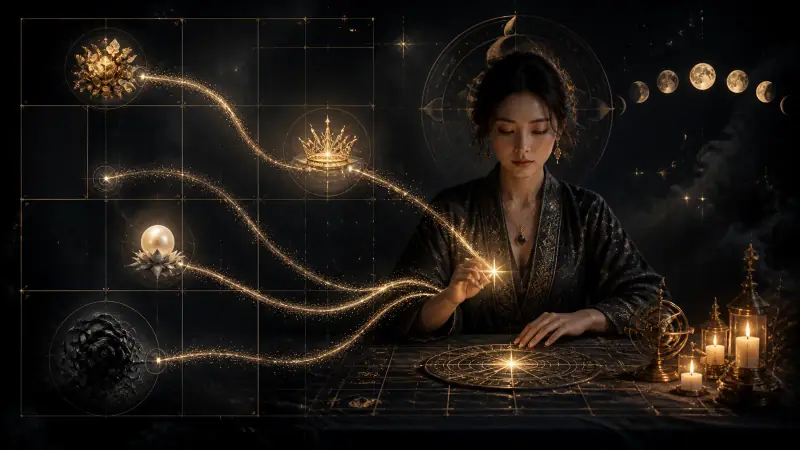
The Four Transformations, also known as "Si Hua Stars," represent one of the most unique and crucial concepts in Zi Wei Dou Shu. They encompass four types of "transformation" energies:
- Hua Lu: The Star of Fortune and Virtue, representing prosperity and interpersonal connections.
- Hua Quan: The Star of Authority, representing control and competition.
- Hua Ke: The Star of Recognition, representing reputation and helpful individuals (noblemen).
- Hua Ji: The Star of Obstacles, representing challenges and persistent attachments.
The character "Hua" itself embodies the meaning of "change" or "transformation." The essence of the Four Transformations lies in the qualitative shifts that occur when Heavenly Stems activate specific stars, leading to dynamic energy conversions from what would otherwise be static stellar influences.
Correspondence Between the Four Transformations and the I Ching
From the perspective of the I Ching, the Four Transformations correspond to the "Yuan, Heng, Li, Zhen" (Originating, Pervading, Furthering, Persevering) virtues:
| Four Transformations | I Ching Correspondence | Deeper Meaning |
|---|---|---|
| Hua Lu | Yuan | Beginning, Origin, Initiation |
| Hua Quan | Heng | Pervading, Development, Expansion |
| Hua Ke | Li | Benefit, Harvest, Achievement |
| Hua Ji | Zhen | Righteousness, Steadfastness, Perseverance |
This correspondence suggests that the Four Transformations can represent four stages in the development of matters: beginning (Lu) → development (Quan) → harvest (Ke) → consolidation (Ji).
Five-Element Attributes of the Four Transformations
Understanding the Five-Element attributes of the Four Transformations can aid in a deeper analysis of their interactive (generating and overcoming) relationships:
- Hua Lu is associated with Metal (some say Earth): outwardly gentle but inwardly firm, its direction is central.
- Hua Quan is associated with Wood: actively upward, possessing vital growth energy.
- Hua Ke is associated with Wood: gentle and refined, valuing reputation.
- Hua Ji is associated with Water: fluid and unpredictable, with a sense of hidden depths.
From the perspective of Five-Element interactions, when Hua Lu and Hua Ji are in the same palace, as Lu (Metal) generates Ji (Water), it may be helpful to be particularly mindful of potential financial considerations that could arise from excessive generosity.
Hua Lu: Prosperity, Interpersonal Connections, Smoothness
Hua Lu is often considered one of the most favorable stars among the Four Transformations, known as the "Star of Fortune and Virtue."
Core Meaning of Hua Lu
Hua Lu represents "abundance" or "generosity." It symbolizes:
- Abundance: Enhances the positive energy of the main star.
- Interpersonal Connections: Harmonious relationships, easily gaining others' favor.
- Prosperity: Smooth financial flow, often experiencing less financial hardship.
- Enjoyment: A more fortunate life, with an appreciation for pleasure.
However, Hua Lu also has aspects that warrant attention. Its deeper meaning is "be cautious at the beginning" – while Hua Lu brings opportunities and resources, it also suggests a potential for challenges if decisions are made too hastily.
Personality Traits Associated with Hua Lu
Individuals with Hua Lu in their Life Palace often exhibit the following traits:
- Easygoing personality, good interpersonal skills.
- When contemplating issues, there may be a tendency to avoid conflict.
- Handles disputes with a diplomatic approach.
- Often possesses higher artistic talent.
- May have a tendency to avoid confronting reality.
Hua Lu in Combination with Other Auxiliary Stars
When Hua Lu combines with different auxiliary stars, various influences may arise:
| Combined Star | Potential Influence |
|---|---|
| Zuo Fu, You Bi | May indicate good management abilities, strong interpersonal connections, and a humorous disposition. |
| Wen Chang, Wen Qu | May suggest rich emotions, artistic talent, and strong expressive abilities. |
| Tian Kui, Tian Yue | May point to favorable financial opportunities, abundant chances, and ease in receiving assistance from helpful individuals. |
| Hua Ke, Hua Quan | May suggest gaining wealth through a good reputation, and being a capable business management talent. |
Influences of Hua Lu in Different Palaces
Hua Lu in the Life Palace: May suggest an easygoing personality, generally well-liked, and easily gaining others' affection.
Hua Lu in the Spouse Palace: May suggest many romantic opportunities and attracting admirers. However, it's also worth noting that there could be complexities arising from having too many choices, or situations that require careful navigation regarding potential external influences in relationships.
Hua Lu in the Wealth Palace: May indicate smooth financial flow and less likelihood of financial scarcity. Opportunities for earning money may arise easily, leading to diverse sources of income.
Hua Lu in the Career Palace: May suggest that finding employment is relatively straightforward, with frequent opportunities for part-time work or promotions. Career prospects may appear smooth.
Hua Lu in the Property Palace: May indicate a comfortable home environment and potential opportunities for acquiring property. Family life may be harmonious.
Hua Quan: Authority, Control, Competition
Hua Quan is associated with Wood and symbolizes "power" among the Four Transformations, representing duality and mastery.
Core Meaning of Hua Quan
Hua Quan represents "control" and "competition." It symbolizes:
- Authority: Influence or leadership in social, professional, or family settings.
- Control: A strong desire to manage or direct matters.
- Proactiveness: Taking initiative and being actively engaged without needing external prompting.
- Assertiveness: At times, a tendency to be overly forceful, which could lead to a more autocratic approach.
Individuals influenced by Hua Quan often possess leadership qualities, but it can also be beneficial to be mindful of the potential challenges that excessive control might present.
Personality Traits Associated with Hua Quan
Individuals with Hua Quan in their Life Palace often exhibit:
- Strong subjective opinions.
- Assertive yet decisive.
- Driven and ambitious.
- Proactive and takes initiative.
- May have a tendency towards competition with others.
Hua Quan in Combination with Strong Main Stars
When Hua Quan is in the same palace as strong main stars, its authoritative characteristics may become more pronounced:
- Zi Wei (Emperor Star) with Hua Quan: May suggest an imperial demeanor and very strong leadership capabilities.
- Lian Zhen (Integrity Star) with Hua Quan: May indicate decisiveness, assertiveness, and strong career ambition.
- Tai Yang (Sun Star) with Hua Quan: May suggest proactiveness, ambition, and public influence.
- Wu Qu (Military Arts Star) with Hua Quan: May indicate both financial and authoritative influence, along with strong executive ability.
- Qi Sha (Seven Killings Star) with Hua Quan: May suggest decisive action, strong determination, and intense competitiveness.
- Po Jun (Army Breaker Star) with Hua Quan: May indicate abundant pioneering spirit and a willingness to take risks.
The Influence of Hua Quan in Different Palaces
Hua Quan in the Life Palace: Individuals may possess an assertive personality and strong leadership abilities, but it's helpful to be mindful of becoming overly dictatorial.
Hua Quan in the Career Palace: There may be opportunities to hold positions of authority in one's career, with potential for advancement. This placement can be well-suited for leadership or managerial roles.
Hua Quan in the Wealth Palace: Individuals may have a strong desire for control over their finances and can be skilled in investment and financial management. However, over-controlling tendencies might lead to missed opportunities.
Hua Quan in the Spouse Palace: In relationships, individuals may tend to be more assertive and influence the direction of the partnership.
Hua Quan in the Children Palace: There may be a strong inclination to take a leading role in children's education, so it's beneficial to ensure children are given appropriate space for their own development.
Hua Ke: Fame, Benefactors, and Academic Fortune
Hua Ke symbolizes "elegance" and "reputation," making it the most refined and graceful among the Four Transformations.
Core Meanings of Hua Ke
Hua Ke represents "academic achievement," "development," and "prominence." It can symbolize:
- Reputation: An enhancement of social status.
- Benefactors: A tendency to receive help and support from others.
- Academic Fortune: Favorable academic prospects and smooth progress in studies.
- Refinement: A distinguished demeanor and graceful speech.
Hua Ke brings an energy of "being seen," which can help individuals stand out in a crowd.
Personality Traits of Hua Ke
Individuals with Hua Ke in their Life Palace often exhibit:
- Refined and elegant qualities
- Amiable and gentle nature
- Eagerness to learn and intelligence
- Not prone to petty disputes
- A preference for stability over drastic changes
The Dual Nature of Hua Ke
While Hua Ke can bring recognition, there are also aspects to be mindful of:
- Fame can attract scrutiny: As one's reputation grows, so might public attention and potential scrutiny.
- Exposure of Privacy: Inner thoughts or private matters might become more public.
- Focus on Appearances: There might be a tendency to sometimes overemphasize outward image.
The Influence of Hua Ke in Different Palaces
Hua Ke in the Life Palace: Individuals may possess a distinguished demeanor, with an academic or refined aura, and tend to earn respect from others.
Hua Ke in the Career Palace: There may be a good reputation in one's career, making it well-suited for professions requiring a public image.
Hua Ke in the Wealth Palace: Financial management may be stable, with an emphasis on saving and planning.
Hua Ke in the Spouse Palace: The partner may possess a refined demeanor, leading to a harmonious relationship where formal recognition (e.g., marriage) is valued.
Hua Ke in the Parents Palace: Individuals may have good relationships with elders and tend to receive support and guidance from mentors or superiors.
Hua Ji: Obstacles, Persistence, and Challenges
Hua Ji is often the most frequently misunderstood star among the Four Transformations. Many beginners feel apprehension when encountering Hua Ji, but this is often based on a misinterpretation.
The True Meaning of Hua Ji
Hua Ji represents "emptiness" or "lack" – areas where one feels insufficient. It can symbolize:
- Insufficiency: An inner sense of lacking.
- Persistence: A strong attachment or dedication towards something.
- Challenges: A tendency to encounter obstacles.
- Motivation: A driving force to strive due to perceived lack.
Hua Ji corresponds to "Zhen" (Perseverance/Righteousness) in the I Ching, with a deeper meaning of "knowing what to do and what not to do." Individuals influenced by Hua Ji often have strong principles, can be relatively unyielding, are often down-to-earth, and may achieve success later in life.
Hua Ji is Not Necessarily Negative
Hua Ji is not inherently bad. As a frequently misunderstood component of the Four Transformations system, Hua Ji actually represents a source of motivation:
- A sense of insufficiency can inspire greater effort.
- Persistence can lead to focused dedication.
- Encountering obstacles can cultivate resilience.
For instance, Tan Lang Hua Ji is not entirely negative; it can represent restraint, leading to greater focus.
Personality Traits of Hua Ji
Individuals with Hua Ji in their Life Palace often exhibit:
- Strong principles
- Can be persistent
- May seem unyielding but is upright
- Down-to-earth
- Achieves success later in life
The Influence of Hua Ji in Different Palaces
Hua Ji in the Life Palace: Individuals may have high self-expectations and be prone to self-criticism, but this can also fuel greater effort.
Hua Ji in the Career Palace: Individuals may encounter challenges in their career, but this can also hone professional skills and expertise.
Hua Ji in the Wealth Palace: Financial management may be more conservative, and saving might be challenging, but they tend to be steady and reliable.
Hua Ji in the Spouse Palace: Individuals may be more persistent in relationships and might encounter relationship challenges, but this also indicates a deep value for relationships.
Hua Ji in the Property Palace: The home environment might experience some changes or challenges, requiring more effort to manage and maintain.
Ten Heavenly Stems Four Transformations Chart
The first step in learning Zi Wei Dou Shu's Four Transformations is memorizing the Heavenly Stems Four Transformations Chart. Each Heavenly Stem activates four specific stars, leading to transformations of Hua Lu, Hua Quan, Hua Ke, and Hua Ji:
| Heavenly Stem | Hua Lu | Hua Quan | Hua Ke | Hua Ji |
|---|---|---|---|---|
| Jia | Lian Zhen | Po Jun | Wu Qu | Tai Yang |
| Yi | Tian Ji | Tian Liang | Zi Wei | Tai Yin |
| Bing | Tian Tong | Tian Ji | Wen Chang | Lian Zhen |
| Ding | Tai Yin | Tian Tong | Tian Ji | Ju Men |
| Wu | Tan Lang | Tai Yin | You Bi | Tian Ji |
| Ji | Wu Qu | Tan Lang | Tian Liang | Wen Qu |
| Geng | Tai Yang | Wu Qu | Tai Yin | Tian Tong |
| Xin | Ju Men | Tai Yang | Wen Qu | Wen Chang |
| Ren | Tian Liang | Zi Wei | Zuo Fu | Wu Qu |
| Gui | Po Jun | Ju Men | Tai Yin | Tan Lang |
How to Use the Heavenly Stems Four Transformations Chart
For example, for someone born in a "Jia" year:
- Locate the palace where "Lian Zhen" resides in your birth chart → That palace will have Hua Lu.
- Locate the palace where "Po Jun" resides → That palace will have Hua Quan.
- Locate the palace where "Wu Qu" resides → That palace will have Hua Ke.
- Locate the palace where "Tai Yang" resides → That palace will have Hua Ji.
These four transformation stars will be distributed throughout your birth chart, offering insights into aspects of your life's journey.
Distinction Between Natal Four Transformations and Flying Star Four Transformations
The Four Transformations in Zi Wei Dou Shu are categorized into two main systems: Natal Four Transformations (Tian Pan / Heavenly Plate) and Flying Star Four Transformations (Gong Gan Si Hua / Palace Stem Four Transformations).
Natal Four Transformations (Tian Pan)
Natal Four Transformations are determined by the Heavenly Stem of your birth year, with the following characteristics:
- Fixed and Unchanging: Remains constant throughout one's life.
- Resident Type: Always attached to the same star.
- Innate Blueprint: Represents inherent behavioral patterns and predispositions.
- Influences Life's Framework: Can offer insights into the overall framework and potential scope of one's life journey.
- Focus on Manifestations: Natal Four Transformations primarily discuss observable patterns and tendencies, rather than directly predicting good or bad fortune.
Flying Star Four Transformations (Palace Stem Four Transformations)
Flying Star Four Transformations are activated by the Heavenly Stems of the Palaces, with the following characteristics:
- Dynamic Changes: Evolve with the passage of time.
- Temporary and Situational: Used for exploring influences during specific periods.
- Acquired Life Trends: Represent the ups and downs across different life stages.
- Exploring Influences: Flying Star Four Transformations primarily discuss life's influences and potential outcomes.
Application of Heaven, Earth, and Human Plates
The application of Four Transformations in Zi Wei Dou Shu is divided into three layers:
| Layer | Name | Source | Meaning |
|---|---|---|---|
| Heaven Plate | Natal Four Transformations | Heavenly Stem of Birth Year | Innate blueprint, shaping lifelong influences. |
| Earth Plate | Decade Four Transformations | Heavenly Stem of Decade Palace | Ten-year influences, highlighting significant themes and potential events. |
| Human Plate | Annual Four Transformations | Heavenly Stem of Annual Palace | Annual influences, resonating with personal experiences and feelings. |
In practical analysis, these three layers of Four Transformations need to be stacked and analyzed together to reveal a comprehensive picture of life's unfolding journey.
Comprehensive Impact of Four Transformations in the Twelve Palaces
Impact of Four Transformations in the Six Kinship Palaces
The Six Kinship Palaces include: Life Palace, Siblings Palace, Spouse Palace, Children Palace, Parents Palace, and Friends Palace.
| Four Transformations | Impact when falling into Six Kinship Palaces |
|---|---|
| Hua Lu | Connections, intelligence, blessings, benefactors, independence, status, longevity |
| Hua Quan | Self-assurance, resourcefulness, talent, strong-willed, stubbornness, assertiveness, drive |
| Hua Ke | Refined, calm, amiable, cultured, benefactors, studious, graceful |
| Hua Ji | Debts/shortcomings, challenges, helplessness, disputes, disorganization, timidity, instability |
Impact of Four Transformations in the Wealth, Career, and Property Triad
The Wealth, Career, and Property Triad includes: Wealth Palace, Career Palace, and Property Palace.
| Four Transformations | Impact when falling into Wealth, Career, and Property Triad |
|---|---|
| Hua Lu | Ease in acquiring wealth, good opportunities, favorable social background, strong capabilities |
| Hua Quan | Busyness, excellent skills, investment, promotion, changes, expansion |
| Hua Ke | Practicality, stability, savings, planning, reputation, benefactors |
| Hua Ji | Challenges in saving, lack of smoothness, mental and physical exertion, susceptibility to petty individuals |
Key Concepts of Four Transformations
Avoid Interpreting Four Transformations Solely as Good or Bad
A common mistake for beginners is to assume Hua Lu and Hua Quan are always good, and Hua Ji is always bad. This is a partial understanding.
Correct Understanding:
- Four Transformations are not inherently good or bad; they reflect authentic human attitudes and experiences.
- Their true influence can only be understood by correlating them with their residing palace.
- Consider the inherent nature of the stars, not just the Four Transformations in isolation.
- A single Hua Ji, if not accompanied by other challenging stars, should not be interpreted as inherently negative.
Differences Between Material and Spiritual Star Types
Material-oriented stars (such as Zi Wei, Qi Sha, Wu Qu, Po Jun) are inherently more assertive. When influenced by Hua Lu and Hua Quan, they can achieve a balance of strength and flexibility.
Spiritual-oriented stars (such as Tian Tong, Tai Yin, Tian Ji) are inherently more introspective. Hua Lu may intensify these characteristics, and even with favorable influences, one might not fully capitalize on opportunities.
The Importance of Stacked Four Transformations
Beyond the Natal Four Transformations in a birth chart, there are also the Four Transformations of the Decade, Annual, and Minor Annual periods. When these Four Transformations stack in the same palace, they create a "chemical reaction," revealing the true dynamics of one's life journey.
Conclusion: Understanding Four Transformations for Self-Awareness
The Four Transformations are the core essence of Zi Wei Dou Shu. Understanding them provides a key to interpreting your birth chart.
Let's review the core meanings of the Four Transformations:
- Hua Lu: Abundance and giving; emphasizing careful beginnings.
- Hua Quan: Control and competition; balancing strength with adaptability.
- Hua Ke: Reputation and benefactors; cultivating both inner and outer qualities.
- Hua Ji: Gaps and persistent focus; often leading to significant achievements later in life.
Remember, the Four Transformations are not inherently good or bad. What's important is understanding their positions and interactions within your birth chart. Through a deeper study of Flying Star Four Transformations, you can gain a more precise understanding of your life's blueprint, recognize opportunities, and navigate challenges.