Learn Tarot from Scratch: A Complete Beginner's Guide
Have you ever been drawn to the mysterious allure of tarot cards, wanting to learn but not knowing where to begin? Tarot books can be hundreds of pages long, the meanings of 78 cards can be overwhelming, and various spreads might seem too complex to even start.
In reality, learning tarot isn't as difficult as you might imagine. This article will guide you through the basic structure of tarot, a learning path, and how to approach your first tarot reading in the simplest way. No special talent or spiritual predisposition is required, just a willingness to learn and practice.
What is Tarot?
Tarot is a set of 78 cards used as an intuitive tool, originating in 15th-century Europe. Initially a card game for nobles, it gradually evolved into a tool for spiritual exploration and self-awareness.
Rather than being a form of "fortune-telling," tarot can be seen as a "medium for dialogue"—through its imagery and symbolic representations, it can help you uncover subconscious thoughts, understand your current energy state, and explore potential future directions.
Tarot vs. Other Intuitive Tools
| Divination Tool | Features | Suitable Scenarios | Learning Difficulty |
|---|---|---|---|
| Tarot Cards | Rich imagery, deep interpretation, can address specific questions | Relationships, career, life choices | Medium (requires learning card meanings and spreads) |
| Birth Chart | Long-term personality analysis, exploration of innate talents | Self-understanding, relationship patterns | Higher (requires learning planets, houses, aspects) |
| I Ching | High philosophical depth, Eastern wisdom | Major decisions, life direction | High (requires understanding hexagrams and classical Chinese) |
| Divination Blocks | Simple and direct, yes/no questions | Divine guidance, simple decisions | Low (but often requires a religious context) |
| Pendulum | Quick, suitable for minor daily questions | Finding objects, simple choices | Low (but accuracy can vary) |
The strength of tarot lies in its balance—it's neither as profound as the I Ching nor as simplified as divination blocks. It can offer rich insights while maintaining a balanced perspective.
The Basic Structure of Tarot Cards
The 78 tarot cards are divided into two main parts: the Major Arcana and the Minor Arcana. Understanding this structure is the first step in learning tarot.
The Major Arcana: 22 Cards of the Spiritual Journey
The Major Arcana consists of 22 cards, numbered from 0 (The Fool) to 21 (The World), representing significant life lessons and stages of spiritual growth.
These 22 cards tell the story of "The Fool's Journey":
- 0 The Fool: Innocent, embarking on a journey
- 1 The Magician: Learning to utilize resources and skills
- 2 The High Priestess: Exploring inner wisdom and intuition
- 3 The Empress: Creativity and abundance
- 4 The Emperor: Establishing order and authority
- 5 The Hierophant: Seeking traditional wisdom and guidance
- 6 The Lovers: Facing choices and relationships
- 7 The Chariot: Willpower and action
- 8 Strength: Gentle resilience
- 9 The Hermit: Introspection and solitude
- 10 Wheel of Fortune: Transformation and opportunity
- 11 Justice: Balance and karma
- 12 The Hanged Man: Letting go and sacrifice
- 13 Death: Endings and rebirth
- 14 Temperance: Harmony and balance
- 15 The Devil: Temptation and bondage
- 16 The Tower: Sudden collapse and awakening
- 17 The Star: Hope and healing
- 18 The Moon: Illusion and the subconscious
- 19 The Sun: Joy and success
- 20 Judgment: Awakening and renewal
- 21 The World: Completion and fulfillment
Importance: When Major Arcana cards appear in a tarot reading, they often suggest significant themes, deeper issues, or potential turning points in one's journey.
The Minor Arcana: 56 Cards of Daily Life
The Minor Arcana consists of 56 cards, divided into four suits, similar to the four suits in a deck of playing cards, representing various aspects of daily life.
The Four Suits and their correspondences:
-
Wands: Element: Fire
- Represents: Action, passion, creativity, career
- Keywords: Vitality, adventure, ambition
- Suitable for questions about: Career development, goal achievement, action plans
-
Cups: Element: Water
- Represents: Emotions, relationships, intuition, love
- Keywords: Feelings, connection, healing
- Suitable for questions about: Romantic relationships, interpersonal relationships, emotional states
-
Swords: Element: Air
- Represents: Thought, communication, conflict, truth
- Keywords: Logic, challenges, decision-making
- Suitable for questions about: Communication issues, mental state, rational analysis
-
Pentacles/Coins: Element: Earth
- Represents: Material, money, health, practicality
- Keywords: Stability, wealth, resources
- Suitable for questions about: Financial situation, job stability, health
Each suit includes:
- Number cards 1-10 (40 cards in total): Representing the developmental stages of that element's energy.
- Court cards (4 cards: Page, Knight, Queen, King, 16 cards in total): Representing different personality traits or actual individuals.
Introduction to Court Cards
Court cards often confuse beginners because they can represent people, personality traits, or advice.
- Page: Youthful, learning, messages, new beginnings
- Knight: Action, pursuit, manifestation of energy
- Queen: Inner mastery, emotional maturity
- King: Outer mastery, authority, achievement
For example:
- Page of Cups: May suggest new emotional beginnings, creative inspiration, or a youthful approach to feelings.
- Knight of Wands: Can represent an adventurous spirit, passionate pursuit, or a period of energetic action.
- Queen of Swords: Might indicate a rational, independent, and insightful female figure or a need for clear, objective thinking.
- King of Pentacles: Could suggest a successful, stable, and reliable male figure or a focus on practical achievement and financial security.
How Should Beginners Start Learning?
The biggest misconception when learning tarot is trying to memorize all card meanings at once. This is not only inefficient but also often leads to giving up. Here is a more effective learning path.
Phase One: Getting to Know the Cards (Weeks 1-2)
Step One: Choose a Suitable Tarot Deck
There are hundreds of tarot decks on the market. For beginners, these are recommended:
Recommended Decks:
- Rider-Waite Tarot: The most classic, abundant resources, clear imagery
- Universal Waite Tarot: A softer version of the Rider-Waite, with warmer colors
- Morgan-Greer Tarot: Enlarged images, easy to observe details
Decks not recommended for beginners:
- Thoth Tarot: Complex symbolism, suitable for advanced learners
- Overly abstract art decks: Difficult to grasp the meaning of the images
Step Two: Draw One Card Daily
There's no need to rush into a tarot reading. Start by building a connection with the cards through a 'daily draw'.
Daily Draw Practice Method:
- After waking up in the morning, shuffle the deck and draw one card.
- Observe the card's imagery: colors, figures, actions, symbols.
- Note your first intuition: What feeling does this card evoke in you?
- In the evening, reflect: How did the day's events resonate with this card?
By consistently doing this for 78 days, you may naturally begin to internalize the basic meanings of all the cards.
Phase Two: Learning Basic Card Meanings (Weeks 3-8)
Instead of memorizing card meanings, focus on understanding their "logic and stories."
Suggested Learning Order:
Weeks 1-2: The 22 Major Arcana cards
- Understand the storyline of The Fool's Journey.
- Familiarize yourself with 3-5 core keywords for each card.
- Observe the card's details and describe them in your own words.
Weeks 3-4: The logic of the Numbered Cards 1-10
- Ace (1): New beginnings, pure energy
- 2: Choices, balance, duality
- 3: Growth, expansion, creation
- 4: Stability, structure, foundation
- 5: Conflict, challenges, change
- 6: Harmony, balance, healing
- 7: Evaluation, reflection, challenges
- 8: Action, movement, mastery
- 9: Nearing completion, wisdom, abundance
- 10: Completion, cycle's end
Combine with the Four Elements, for example:
- Five of Wands (Fire + Conflict) = Competition, disagreements
- Two of Cups (Water + Balance) = Emotional connection, partnership
- Five of Swords (Air + Conflict) = Disputes, perceived setbacks, humiliation
- Ten of Pentacles (Earth + Completion) = Wealth, family, legacy
Weeks 5-6: The 16 Court Cards
- First, understand the characteristics of the four elements.
- Then, understand the characteristics of the four ranks (Page, Knight, Queen, King).
- Combine them for understanding (e.g., King of Wands = Mature mastery of the Fire element).
Phase Three: Beginning Practical Readings (From Week 9 Onwards)
Start with simple questions and spreads.
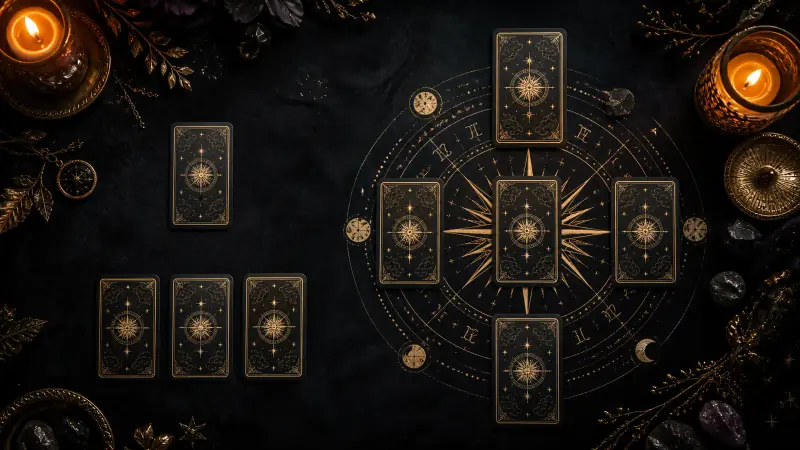
Beginner-Friendly Spreads:
-
Single Card (Simplest)
- Suitable for: Daily guidance, quick reflection.
- Example question: "What might be helpful for me to focus on today?"
-
Three-Card Spread (Most Practical)
- Past - Present - Potential Future
- Situation - Action - Potential Outcome
- You - The Other Person - The Relationship
-
Five-Card Spread (Advanced)
- Central Question, Past Influences, Potential Future Trends, Advice, Potential Outcome
Reading Steps:
Step 1: Formulate a Clear Question
- Good question: "What aspects might I consider focusing on in this relationship?"
- Less effective question: "Does he love me?" (Too binary, limits exploration)
Step 2: Shuffle the Cards
- The method is flexible; the key is to focus on your question.
- Stop when it "feels right."
Step 3: Draw Cards
- You can cut the deck, fan them out and choose, or draw from the top.
- Trust your intuition.
Step 4: Interpret the Cards
- First, observe the overall impression: Do the cards lean more towards a positive or challenging tone?
- Then, look at the details: The meaning of each card in its specific position within the spread.
- Finally, integrate: Weave all the cards together into a cohesive narrative.
Step 5: Journal Your Reading
- Write down your question, the cards drawn, your interpretation, and any subsequent reflections or developments.
- Review it after a month to observe how the insights resonated with your experiences.
Interpretation Techniques: Beyond Memorizing Meanings
Many beginners assume learning tarot is solely about memorizing card meanings. However, interpretation is an art that requires integrating various techniques.
Technique 1: Observe Image Details
Don't rush to consult a book for card meanings; first, carefully observe the image.
Key Observation Points:
- Figure's expression: Happy? Sad? Peaceful?
- Posture/Action: Active? Passive? Defensive?
- Colors: Warm tones (red, orange, yellow) or cool tones (blue, green, purple)?
- Symbols: What do the sun, moon, water, mountains, buildings represent?
- Direction: Is the figure facing left (often associated with the past) or right (often associated with the future)?
For example: Three of Swords
- Image: A heart pierced by three swords, with a stormy, rainy sky in the background.
- Intuitive interpretation: Heartache, sorrow, emotional wounds.
- Traditional meaning: Heartbreak, loss, emotional pain.
When your observations align with traditional card meanings, the understanding can become more deeply ingrained.
Technique 2: Combine with Position Meaning
The interpretation of the same card can vary depending on its position in a spread.
For example: Two of Cups in different positions
Position: Past
Interpretation: You may have experienced a beautiful emotional connection.
Position: Present
Interpretation: You might be in the process of building a balanced relationship.
Position: Potential Future
Interpretation: There's an opportunity to develop a stable partnership.
Position: Advice
Interpretation: Seek emotional balance and mutual respect.
Technique 3: The Dialogue Between Cards
Instead of interpreting each card in isolation, observe how they interact with each other.
For example: Three-card combinations
Combination 1: Past (Three of Swords) - Present (The Hermit) - Potential Future (The Star)
Interpretation: You may have experienced heartache (Three of Swords), and are now choosing solitude for reflection and healing (The Hermit). The potential future suggests a renewed sense of hope and inspiration (The Star). This can be seen as a journey of healing.
Combination 2: You (The Lovers) - The Other Person (Two of Swords) - The Relationship (The Tower)
Interpretation: You may be seeking a deep connection (The Lovers), while the other person appears hesitant or conflicted (Two of Swords). Without open communication, there's a potential for sudden, transformative shifts in the relationship (The Tower).
Technique 4: Trust Your Intuition
Tarot offers no absolute standard answers; your intuition plays a crucial role.
Intuition Practice Method:
- After drawing a card, avoid consulting a book immediately.
- Gaze at the card for 30 seconds.
- Articulate the first word or feeling that comes to mind.
- Then, compare it with traditional card meanings.
Often, your initial intuitive insights can offer a perspective that resonates deeply with your personal truth, sometimes even more so than textbook explanations.
Tip 5: Understanding Reversed Cards
Reversed cards (when a card appears upside down) are a common point of confusion for beginners.
Interpreting Reversed Cards:
Method 1: Weakened or Blocked Energy
- Reversed Sun: Joy and success may feel hindered, but not entirely absent.
- Reversed Strength: May suggest a lack of patience or self-confidence.
Method 2: Excessive or Distorted Energy
- Reversed Emperor: Could indicate excessive control or authoritarian tendencies.
- Reversed Knight of Cups: Might suggest being overly romantic or impractical.
Method 3: Internalized Aspects
- Reversed Hermit: May point to self-isolation or a reluctance to connect with others.
- Reversed Chariot: Could reflect inner conflict, hindering forward movement.
Beginner Tips:
- In the initial learning phase, you might choose to focus on upright meanings first.
- Once comfortable, incorporate reversed cards to add depth to your readings.
7 Common Mistakes Beginners Make
Avoiding these pitfalls can make your learning journey smoother.
Mistake 1: Over-reliance on Book Definitions
Symptom: Consulting a book for card meanings every time you draw a card, memorizing them verbatim.
Issue: Tarot is fluid and requires interpretation in context. Rote memorization can limit your intuition.
Solution: First, describe the card in your own words, then compare it with book definitions to gradually build your personal interpretation system.
Mistake 2: Asking Vague Questions
Symptom: Questions like "What does my future hold?" or "Will I be happy?"
Issue: Overly broad or vague questions may not yield insightful reflections from tarot.
Solution: Ask specific, actionable questions.
- Instead, try: "What aspects of my career might I focus on in the next three months?"
- Instead, try: "How might I enhance communication in this relationship?"
Mistake 3: Repeatedly Asking the Same Question
Symptom: Redrawing cards if you don't like the outcome, until you get a "satisfying" answer.
Issue: This can dilute the clarity of the reflection and may be a form of self-deception.
Solution: For the same question, consider waiting at least 2-4 weeks, or until there's a significant change in circumstances, before seeking further reflection.
Mistake 4: Treating Tarot as Absolute Prediction
Symptom: Drawing the Death card and assuming "someone will definitely die."
Issue: Tarot offers insights into current energies and potential paths; your actions and choices can influence future outcomes.
Solution: View tarot as a tool for guidance and self-awareness, rather than an unchangeable prophecy.
Mistake 5: Ignoring the Overall Spread
Symptom: Focusing solely on one "negative" card while overlooking other positive indicators.
Issue: A single card doesn't tell the whole story; a holistic interpretation of the spread is essential.
Solution: First, observe the overall trend (are most cards generally supportive or challenging?), then delve into individual card meanings.
Mistake 6: Reading for Unwilling Individuals
Symptom: Offering a reading to a friend who hasn't asked for one.
Issue: Without the individual's willingness, the connection for reflection may be weaker, and it could potentially cause discomfort.
Solution: Only offer readings to those who explicitly ask, respecting their autonomy.
Mistake 7: Expecting Instant Mastery
Symptom: Expecting to become a professional reader and interpret complex questions after only a week of learning.
Issue: Developing a deep understanding of tarot requires time and experience; rushing the process can lead to frustration.
Solution: Allow yourself at least 3-6 months for dedicated learning, practicing regularly to gradually build your skills.
Recommended Learning Resources
To continue your growth, these resources can be very helpful.
Chinese Books
Beginner Level:
- "16 Lessons to Learn Tarot": Offers a systematic learning structure.
- "You're Already Quite Tarot": A lighthearted and engaging introductory book.
- "Tarot Sunflower Manual": Provides detailed card interpretations.
Advanced Level:
- "Tarot Meditations": For a deeper understanding of symbolic meanings.
- "Jung and Tarot": Explores tarot from a psychological perspective.
English Resources (Advanced)
- "78 Degrees of Wisdom" by Rachel Pollack: Often considered a foundational text for tarot.
- "The Tarot Bible" by Sarah Bartlett: Features detailed illustrations and explanations.
Online Resources
- YouTube Channels: Search for "tarot tutorials" for many free lessons.
- Instagram Accounts: Follow tarot readers to observe their interpretation approaches.
- Podcasts: Listen to tarot-related shows during your commute.
Practice Communities
- Join Facebook Groups: Search for "Tarot Card Exchange" or "Tarot Learning."
- Dcard Tarot Board: Explore others' case studies and interpretations.
- PTT Tarot Board: Discuss card meanings and reading experiences.
Key Point: Don't just read; actual practice and journaling your readings are among the most effective ways to learn.
Ethics and Considerations
Understanding basic ethical guidelines is also part of learning tarot.
Ethical Reading Practices
-
Respect Privacy
- Do not disclose the content of others' readings.
- Do not offer readings to strangers without their explicit consent.
-
Honest Interpretation
- Avoid sugarcoating or exaggerating outcomes.
- Do not misrepresent insights to please the querent.
-
Avoid Medical, Legal, or Financial Advice
- Do not diagnose illnesses or advise on medication.
- Do not offer professional legal or financial advice.
- For serious concerns, always recommend seeking assistance from qualified professionals.
-
Do Not Predict Death or Catastrophe
- Even if cards like Death or The Tower appear, avoid making definitive statements about death or disaster.
- The Death card typically symbolizes transformation, and The Tower often represents sudden change or revelation.
Traditional Considerations (Optional)
- Do not lend your cards to others: Some believe each deck develops its own unique energy.
- Do not let others casually touch your cards: This is often seen as respecting your tools.
- Do not read when highly emotional: It is thought this can influence the clarity of the reflection.
- Do not ask questions like "When will I die?": This is generally considered unethical and outside the scope of reflective tools.
But remember: These are traditional beliefs, not absolute rules. The most important aspects are respect and a responsible approach.
How to Create Your Own Tarot Ritual
Rituals are not mandatory, but they can help you enter a focused state.
Simple Ritual Example
-
Clear Your Space
- Light essential oils, incense, or play meditative music.
- Tidy your reading surface, keeping it clean.
-
Cleanse Your Cards (Optional)
- Methods: Smudging (with sage), moonlight charging, tapping the back of the deck.
- Frequency: When you feel the energy is muddled, or after a long period of disuse.
-
Meditate and Center Yourself
- Take three deep breaths to calm your mind.
- Focus on your question.
-
Shuffle and Draw Cards
- Shuffle in a way that feels comfortable to you.
- Stop when it feels "enough."
-
Interpret and Journal
- Carefully observe the cards and write down your interpretations.
- Record the date and any subsequent developments.
-
Conclude and Express Gratitude
- Neatly put the cards back in order.
- You can thank your cards (if you wish).
Key Point: The purpose of a ritual is to help you focus, not to engage in mysterious esotericism. Feel free to use whatever approach feels comfortable to you.
Frequently Asked Questions Q&A
Do I need spiritual talent to learn Tarot?
No, not at all. Tarot is more like a 'language' that anyone can learn. What is often perceived as 'relevance' or 'insightfulness' stems from a deep understanding of card meanings, accumulated interpretation experience, and insight into human nature, rather than supernatural abilities.
How long does it take to be able to read for others?
It's generally suggested to practice for at least 3-6 months and to have performed at least 50-100 tarot readings for yourself. Once you feel confident in your interpretations and understanding, then consider offering readings to others. Don't rush into 'becoming a reader'; a solid foundation is far more important.
Are tarot readings truly accurate?
The perceived relevance or insightfulness of a tarot reading can vary from person to person. Factors that can influence the depth of insight include: interpretation skills, the clarity of the question asked, and the openness of the individual receiving the reading. Tarot is not a scientific instrument, but rather a tool that offers insights through symbolic imagery.
Can I do a tarot reading for myself?
Yes, you can, but be mindful of 'subjective bias'. When reading for yourself, it's easy to be influenced by emotions, and interpretations might lean towards what you hope to see. Suggestion: For significant or complex issues, it can be helpful to seek assistance from another reader. For daily questions or personal reflection, practicing on your own is beneficial.
Which tarot deck is best to buy?
For beginners, the Rider-Waite Tarot deck is highly recommended. Avoid buying overly expensive or flashy decks initially; classic designs are best for learning. Once you've gained proficiency, you can then explore and collect other decks based on your personal preferences.
Is a deck activation ritual necessary?
Not necessarily. Traditional 'deck activation' rituals (such as sleeping with the deck under your pillow, or more extreme practices) are based on old beliefs and lack scientific basis. What's truly important is to respect and engage with your cards, rather than the ritual itself.
Conclusion: Tarot is a Lifelong Journey of Learning
Learning Tarot is not about becoming a fortune-teller. Instead, it's about using this symbolic system to better understand yourself, empathize with others, and gain different perspectives at life's crossroads.
The 78 cards are like 78 mirrors, reflecting the various facets of life: love, loss, growth, challenges, hope, and fear. Each tarot reading is an opportunity for a deep conversation with yourself.
Final advice for beginners:
- Don't rush; taking your time often leads to faster progress.
- Practice daily and be persistent.
- Journal your tarot readings, review, and reflect.
- Trust your intuition; don't just memorize.
- Maintain curiosity and an open mind.