Minor Arcana: A Quick Guide to the 56 Cards
If the Major Arcana is the soul of tarot, the Minor Arcana is its flesh and blood — depicting the textures of everyday life: work challenges, emotional entanglements, money worries, and human interactions.
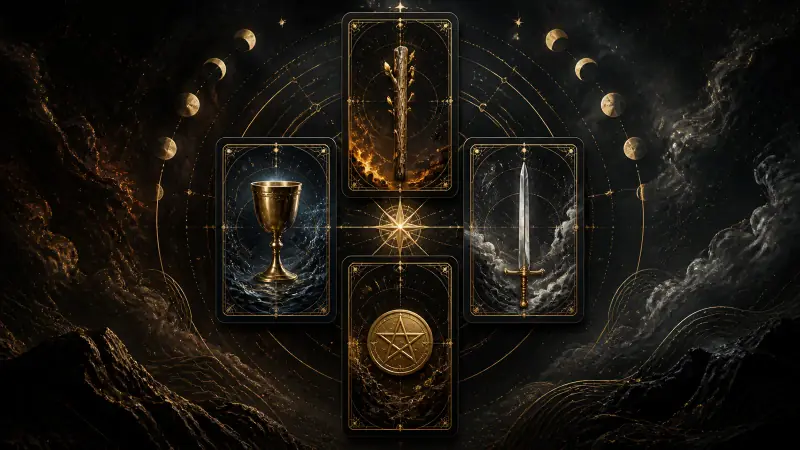
The 56 minor cards are divided into four suits, each with 14 cards, corresponding to four elemental energies. The key to understanding the Minor Arcana is not memorizing 56 card meanings by heart, but mastering the systemic logic of "element + number + court rank."
This article walks you through a complete reading system for the minor cards — from the qualities of the four elements to the logic of numbers, from the personalities of court cards to practical application — so you can quickly grasp the core meanings of all 56 cards.
The Structural Logic of the Minor Arcana
Composition of the 56 minor cards:
4 Suits × 14 Cards = 56 Cards
- Numbered Cards: Ace (1) to 10, totaling 40 cards
- Court Cards: Page, Knight, Queen, King, totaling 16 cards
Three dimensions for interpreting minor cards:
Dimension 1: Elemental Quality (which suit)
Defines the basic energy type of the card: Fire, Water, Air, Earth
Dimension 2: Number Significance (1–10)
Indicates the developmental stage and intensity of that elemental energy
Dimension 3: Court Rank (Page to King)
Suggests character traits, maturity level, or a specific person
Example: Three of Wands = Fire element (action) + number 3 (expansion) = broadening plans, reaching outward.
Detailed Breakdown of the Four Suits
Suit of Wands: Fire Element
Core Keywords: Action, Passion, Creativity, Career, Ambition
Elemental Qualities:
Fire represents initiative, enthusiasm, creativity, and vitality. The suit of Wands concerns itself with “what to do,” “how to act,” and “the pursuit of goals.”
Reflective Questions:
- Career development: “What can I reflect on about this job opportunity?”
- Project execution: “What might I discover about my entrepreneurial journey?”
- Direction of action: “What inner inclinations might guide my next steps?”
- Drive and passion: “How might I sustain my enthusiasm for this endeavor?”
Positive Traits: Proactive, energetic, creative, adventurous
Challenging Traits (when reversed or overly expressed): Impulsive, restless, impatient, excessively competitive
When many Wand cards appear in a tarot reading:
Life is full of action and change; you may need to make a choice or take initiative.
When few Wand cards appear: A sense of stagnation or lack of drive; consider what might reignite your passion.
Suit of Cups: Water Element
Core Keywords: Emotion, Relationship, Intuition, Love, Creativity
Elemental Qualities:
Water represents feeling, intuition, flow, and connection. The suit of Cups explores “what you feel,” “the state of relationships,” and “emotional needs.”
Reflective Questions:
- Romantic relationships: “What insights can I gain about the depth and sustainability of this connection?”
- Emotional state: “What am I truly feeling right now?”
- Interpersonal bonds: “How might I nurture my friendships more fully?”
- Creative inspiration: “Where can I look for a wellspring of creative inspiration?”
Positive Traits: Gentle, empathetic, emotionally rich, nurturing connections
Challenging Traits (when reversed or overly expressed): Overly emotional, hypersensitive, escapist, dependent
When many Cup cards appear in a tarot reading:
Emotional life is rich; relationships are a focus; pay attention to how you manage your feelings.
When few Cup cards appear: Possible emotional closure or disconnection; explore ways to open your heart.
Suit of Swords: Air Element
Core Keywords: Thinking, Communication, Conflict, Truth, Decision
Elemental Qualities:
Air represents thought, logic, communication, and truth. The suit of Swords focuses on “how you think,” “how to communicate,” and “facing reality.”
Reflective Questions:
- Communication challenges: “What might help me communicate more effectively?”
- Difficult choices: “What deeper values should I consider when weighing these options?”
- Mental state: “What might be the roots of my anxiety?”
- Seeking truth: “What perspectives am I not seeing in this situation?”
Positive Traits: Rational, clear-minded, analytical, truth-seeking
Challenging Traits (when reversed or overly expressed): Overthinking, anxiety, coldness, sharpness
When many Sword cards appear in a tarot reading:
Thoughts may be tangled, stress high, conflicts frequent; a time for calm reflection and clear thinking.
When few Sword cards appear: Avoiding rational analysis or uncomfortable truths; invite honest self-examination.
Note: The suit of Swords is often seen as a “challenging” suit because it deals with pain, conflict, and uncomfortable truths — yet these are all necessary parts of growth.
Suit of Pentacles: Earth Element
Core Keywords: Material World, Finances, Health, Practicality, Stability
Elemental Qualities:
Earth represents the material world, stability, practicality, and resources. The suit of Pentacles reflects on “what you have,” “how you manage resources,” and “material security.”
Reflective Questions:
- Financial situation: “What does my current relationship with money reveal to me?”
- Job stability: “How can I reflect on the security and growth potential of my work?”
- Material needs: “What can I learn about my values when choosing between saving and investing?”
- Health: “What small, practical steps might support my physical well-being?”
Positive Traits: Stable, grounded, reliable, resourceful
Challenging Traits (when reversed or overly expressed): Materialistic, rigid, greedy, overly conservative
When many Pentacle cards appear in a tarot reading:
A focus on material security and finances; a good time for grounded, practical planning.
When few Pentacle cards appear: May indicate a lack of concrete action or follow-through; bring plans down to earth.
Important: A tarot reading is a tool for self-reflection — it is not a substitute for professional financial, medical, or legal advice. For real-world money decisions, health concerns, or legal matters, please consult a qualified professional.
The General Logic of Numbered Cards 1–10
Understanding the developmental stages of the numbers helps you quickly grasp the core meaning of all 40 numbered cards.
Ace (1): A Pure Beginning
Keywords: new start, potential, seed, gift
The four Aces:
- Ace of Wands: new project, creative inspiration, an opportunity for action
- Ace of Cups: new feeling, emotional connection, the start of love
- Ace of Swords: new idea, truth revealed, mental breakthrough
- Ace of Pentacles: new work, material opportunity, a foundation in the physical world
In a reading: An Ace invites you to recognize seeds of potential and consider what action might nurture them.
Number 2: Choice and Balance
Keywords: duality, choice, balance, partnership
- Two of Wands: choosing a direction, the world in your hands, waiting for the right moment
- Two of Cups: emotional connection, partnership, balanced love
- Two of Swords: a difficult choice, avoiding a decision, a standoff
- Two of Pentacles: balancing resources, multi-tasking, staying flexible
In a reading: The number 2 often points to a choice or the need to balance two areas of life.
Number 3: Growth and Expansion
Keywords: growth, expansion, collaboration, creation
- Three of Wands: expanding outward, a plan in motion, far-sightedness
- Three of Cups: celebration, friendship, shared joy
- Three of Swords: heartbreak, betrayal, emotional pain
- Three of Pentacles: skill on display, teamwork, professional recognition
In a reading: The number 3 can signal that something is beginning to grow and take shape.
Number 4: Stability and Structure
Keywords: stability, foundation, structure, consolidation
- Four of Wands: celebration, stability, homecoming, harmony
- Four of Cups: dissatisfaction, boredom, overlooking an opportunity
- Four of Swords: rest, recovery, a temporary retreat
- Four of Pentacles: control, caution, holding tightly to resources
In a reading: The number 4 often reflects a stable foundation being built, though it can also hint at rigidity.
Number 5: Conflict and Challenge
Keywords: challenge, conflict, change, disorder
- Five of Wands: competition, disagreement, chaos
- Five of Cups: loss, grief, focusing on what is missing
- Five of Swords: conflict, defeat, a victory that may feel unfair
- Five of Pentacles: scarcity, feeling excluded, material hardship
In a reading: The number 5 tends to be challenging, yet challenges can open the door to growth.
Number 6: Harmony and Re-balance
Keywords: harmony, balance, giving, receiving, healing
- Six of Wands: victory, good news, public recognition
- Six of Cups: nostalgia, childhood, sweet memories, giving
- Six of Swords: transition, leaving a difficult situation, moving forward
- Six of Pentacles: generosity, giving and receiving, balanced exchange
In a reading: The number 6 invites you to discover balance again after the chaos of 5.
Number 7: Assessment and Reflection
Keywords: evaluation, choice, reflection, challenge
- Seven of Wands: defense, standing your ground, competition
- Seven of Cups: fantasy, many choices, unrealistic expectations
- Seven of Swords: deception, strategy, covert action
- Seven of Pentacles: waiting, assessing, patiently observing the results
In a reading: The number 7 is a stage of reflection, encouraging you to consider your next move.
Number 8: Action and Mastery
Keywords: action, movement, control, rapid development
- Eight of Wands: swift movement, messages, travel, fast progress
- Eight of Cups: leaving, letting go, seeking something more
- Eight of Swords: feeling trapped, limitation, a sense of powerlessness
- Eight of Pentacles: skill, focus, dedicated effort
In a reading: The number 8 often signals rapid movement of energy or focused, deliberate action.
Number 9: Near Completion
Keywords: nearing the finish, wisdom, abundance, preparation
- Nine of Wands: perseverance, being on guard, close to the end
- Nine of Cups: wishes fulfilled, contentment, emotional satisfaction
- Nine of Swords: anxiety, nightmares, fear (often amplified by the mind)
- Nine of Pentacles: independence, abundance, enjoying the fruits of your effort
In a reading: The number 9 suggests you are nearing your goal; a final push may still be needed.
Number 10: Completion and Cycle
Keywords: completion, ending, cycle, culmination
- Ten of Wands: a heavy load, too many responsibilities, approaching the end but feeling exhausted
- Ten of Cups: family happiness, emotional fulfillment, long-term harmony
- Ten of Swords: an ending, a painful conclusion, the darkness before renewal
- Ten of Pentacles: wealth, legacy, heritage, material fulfillment
In a reading: The number 10 marks the close of a cycle; a new cycle may be ready to begin (returning to the Ace energy).
The 16 Court Cards: Character Analysis
Court cards can be the most nuanced part of the tarot because they can represent:
- An actual person (someone you know)
- Personality traits (aspects of yourself or another)
- An invitation (to embody a certain quality in a situation)
The four stages of maturity:
Page: learning, messages, new beginnings
- Curious, youthful, in a learning phase
- May point to a child, a student, or a beginner
- Can also suggest new information or a fresh opportunity
Knight: action, pursuit, expression
- Full of energy, enthusiasm, chasing an aim
- May represent a young person or someone action-oriented
- Can indicate a surge of focused energy
Queen: inner mastery, emotional maturity
- Mature, reflective, emotionally rich
- Typically connected to feminine or receptive energy
- Embodies the inward, nurturing aspect of the element
King: outer mastery, authority, accomplishment
- Mature, authoritative, outward-facing, in command
- Typically connected to masculine or directive energy
- Embodies the outward, decisive aspect of the element
Wands Court Cards: The Energetic Action-Takers
- Page of Wands: enthusiastic news, a new plan, the young adventurer
- Knight of Wands: impulsive, adventurous, passionate pursuit, swift action
- Queen of Wands: warm, confident, charismatic, skilled at inspiring others
- King of Wands: visionary, strong leadership, entrepreneurial, ambitious
Cups Court Cards: The Emotionally Rich Feelers
- Page of Cups: emotional messages, creative inspiration, the start of affection
- Knight of Cups: romantic, idealistic, emotional pursuit, a suitor
- Queen of Cups: gentle, empathetic, emotionally mature, a natural healer
- King of Cups: emotionally steady, wise, a skilled counselor, diplomat
Swords Court Cards: The Clear, Rational Thinkers
- Page of Swords: curious, alert, new ideas, keen observation
- Knight of Swords: rational, direct, truth-seeking (can come across as rash)
- Queen of Swords: independent, analytical, sharp insight (may appear aloof)
- King of Swords: rational authority, fair, decisive, a professional approach
Pentacles Court Cards: The Practical, Steady Doers
- Page of Pentacles: learning a new skill, practical news, the dedicated student
- Knight of Pentacles: reliable, patient, steady progress, grounded action
- Queen of Pentacles: practical, cares for the home and everyday world, skilled with resources, nurturing
- King of Pentacles: accomplished in work and finances, a dependable leader, long-term stability
Practical Application of Court Cards
How to interpret what a court card represents?
Scenario 1: Asking “Is he interested in me?”
You draw: Knight of Cups
Possible interpretations:
- The person may be romantic and emotionally expressive (personality trait)
- This card could point toward someone who takes initiative in love or it might encourage a confident, heartfelt approach (action suggestion)
- He might be working up the courage to confess his feelings (reflection of an actual person’s state)
Scenario 2: Asking “How can I improve my work performance?”
You draw: King of Pentacles
Possible interpretations:
- It may suggest projecting a steady, reliable, and professional image (advice)
- A person like a senior colleague or mentor could offer valuable guidance (actual person)
- Focusing on tangible results and financial goals can be beneficial (quality to embody)
Scenario 3: Asking “Who might be a helpful ally for me?”
You draw: Queen of Swords
Possible interpretations:
- This could represent a rational, independent, and insightful woman (actual person)
- She might work in a field like consulting, law, or analysis
Tips for identifying who or what a court card points to:
Tip 1: Connect the card to the question type
- When asking about a person → it often refers to a real person
- When asking for advice → it tends to highlight a personality trait or a way of acting
- When asking about the future → it could indicate someone you’ll meet or a quality you might need to develop
Tip 2: Observe the surrounding cards
- Court card + numbered minor arcana → the situation this person is going through
- Court card + major arcana → the person’s significance or deeper life themes at play
Tip 3: Trust your intuition
- When a court card appears, the first person who comes to mind is often a meaningful clue.
Quick Memorization Methods for the Minor Arcana
Method 1: Element + Number Combination
Rather than memorizing each card in isolation, grasp the overall logic of “element quality + number stage.”
Example: Five of Cups
- Cups = emotions
- Five = conflict, loss
- Combined = emotional disappointment and a sense of loss
Method 2: Visual Memory
Observe the card image carefully and link it to a short story.
Example: Three of Swords
- Image: a heart pierced by three swords, rain falling in the background
- Story: the pain of heartbreak, as sorrowful as rain
- Memory cue: emotional wound, heartache
Method 3: Practice with Daily Draws
Draw one card a day, note what happens, and then look back at the card meaning.
Example: You draw the Eight of Wands in the morning
- Expectation: this often points to swift developments or messages
- Reality: you get a job offer call in the afternoon
- Reflection: the Eight of Wands indeed often signals rapid communication and progress
Method 4: Comparative Memorization
Place similar cards side by side and highlight their differences.
Example: Two of Cups vs. Ten of Cups
- Two of Cups: a connection between two people (beginning, partnership)
- Ten of Cups: family happiness and emotional fulfillment (completion, long-term)
- Difference: the progression from a romantic bond to a stable, loving home
Applying the Minor Arcana in a Tarot Reading
Minor Arcana vs. Major Arcana Proportions
Mostly Minor Arcana:
- Everyday matters, situations you can influence
- The question may be relatively straightforward or surface-level
- You tend to have more agency and choice
Major Arcana outnumber Minor:
- Could reflect significant events or deeper issues
- Might involve life lessons or turning points
- Situations may feel beyond your immediate control
A balanced mix:
- A normal life rhythm
- Challenges exist but resources are available as well
Element Balance Analysis
If a reading shows a strong emphasis or lack of a particular element:
Many Wands: life feels full of action and change; you might be overextending yourself
Few Wands: motivation may be low; it could be time to rekindle your passion
Many Cups: emotions run deep; there may be a tendency toward moodiness or sentimentality
Few Cups: emotional expression might feel blocked; opening your heart could be helpful
Many Swords: overthinking and mental pressure may be present; finding ways to relax the mind is valuable
Few Swords: rational analysis might be underused; ground yourself in clear thinking
Many Pentacles: strong focus on the material world; be mindful of becoming overly pragmatic or fixated on gain
Few Pentacles: practicality may need a boost; a more grounded approach can bring stability
Number Distribution Analysis
Many low numbers (1–3): new beginnings, early stages, things are still unfolding
A lot of middle numbers (4–6): stability, building foundations, a balanced state
Many high numbers (7–10): nearing completion, maturity, readiness for a shift
Common Q&A
Which is more important, the Minor Arcana or the Major Arcana?
Both are essential, but they play different roles.
Major Arcana: major life themes and turning points (soul-level perspectives)
Minor Arcana: concrete, day-to-day situations (practical, everyday aspects)
A metaphor: the Major Arcana are like the main plot of a life story, while the Minor Arcana are the daily lines and movements that bring it to life.
Why do Swords cards often look so harsh?
Swords deal with thought, conflict, and truth—processes that can involve pain. Yet pain does not equal negativity.
Example: The Three of Swords (heartbreak) may be painful, but it can also represent an unavoidable part of growth.
An important perspective: there are no inherently “bad” cards, only lessons we might need to face.
How do I interpret reversed court cards?
Common themes for reversed court cards:
Meaning 1: Energy may be diminished or immature
- Reversed King of Wands: could reflect less confidence in leadership or ambition that feels unfocused
Meaning 2: Energy might be excessive or expressed in challenging ways
- Reversed Knight of Cups: could point to overly romantic or unrealistic attitudes, or a tendency to play with emotions
Meaning 3: The quality is internalized or hidden
- Reversed Queen of Swords: might show a sharp mind held behind a gentle exterior, or inner detachment
Meaning 4: An invitation to develop this trait
- Reversed King of Pentacles: could encourage learning steadiness and better financial awareness
What if I draw cards from different elements for the same question?
That’s completely natural; most questions touch multiple layers of life.
Example: “Will this relationship work out?”
A Wands card appears: it draws attention to action, passion, and shared endeavors
A Cups card appears: it highlights emotional connection and how you feel together
A Swords card appears: it suggests looking at communication and whether honesty is present
A Pentacles card appears: it brings focus to practical stability and shared material ground
Each element offers a different angle of insight, not a contradiction.
How do I tell if a reversed card points to “excess” or “lack”?
Let the context guide you:
Excess: if the querent already leans strongly into the card’s upright quality, the reversal may hint at overdoing it.
- Example: a workaholic drawing the reversed Eight of Pentacles → might suggest burnout from excessive effort, neglecting other areas of life.
Lack: if the querent seems distant from the card’s upright energy, the reversal could point to an underdeveloped aspect.
- Example: someone who has been feeling unmotivated drawing the reversed Eight of Pentacles → could be an invitation to cultivate more focus and consistent effort.
A helpful tip: before interpreting, take a moment to understand the querent’s current state and how the card’s qualities might relate.
Summary
The 56 cards of the Minor Arcana may seem numerous, but once you grasp the system of “four elements + number logic + court card ranks,” you can quickly understand the core meaning of each card.
Keep these points in mind:
- Avoid rote memorization; understanding the underlying logic is far more valuable.
- The card image is your best teacher—study it closely.
- Practical, hands‑on practice is the fastest way to learn.
- Weave together Major and Minor Arcana for a fuller reading.
Tarot is a living language. The more you work with the cards, the richer their meanings become. Stay curious, and enjoy the process of discovery.