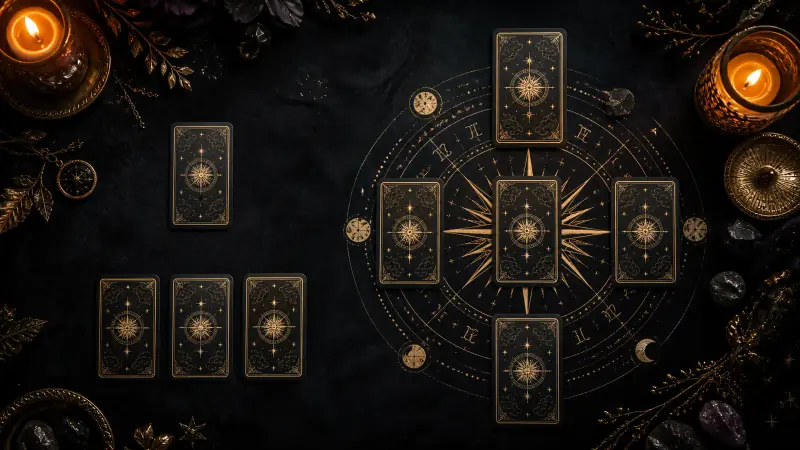
Position 1: Their feelings toward you right now
Position 2: Hidden factors affecting their feelings
Position 3: Reflective guidance on how this connection might evolve
Case 3: Read but no reply after meeting online
Background: Linda went on a date with someone she met on a dating app, and he left her on read for two days.
Cards drawn:
- Position 1: Five of Wands (upright)
- Position 2: The Lovers (reversed)
- Position 3: The Chariot
Interpretation:
The reading suggested that he’s currently juggling several things (Five of Wands) and may be dating multiple people (The Lovers reversed) — you may not be the only option. The advice was to reach out with a warm message to express interest (The Chariot), but keep expectations in check.
Outcome: Linda invited him for a second date; he politely declined, saying he’d been busy lately — a gentle way of showing he wasn’t interested.
Case 4: Longtime friend with ambiguous feelings
Background: Xiao An and a university classmate had been close friends for five years. She recently realized she had deeper feelings for him.
Cards drawn:
- Position 1: Knight of Cups
- Position 2: Seven of Swords
- Position 3: The Fool
Interpretation:
The cards indicated he also has feelings for her (Knight of Cups), but he worries a confession might ruin the friendship (Seven of Swords), so he’s held back. The suggestion was to gently create moments that feel “more than friends” (The Fool) — for example, a slightly flirty message or a chance to be alone together.
Outcome: On his birthday, Xiao An gave him a thoughtful gift. He confessed his feelings that very evening.
Case 5: Office crush with a policy in the way
Background: Tony and a female colleague in the same department liked each other, but their company had a strict no-dating policy for team members.
Cards drawn:
- Position 1: Two of Cups
- Position 2: The Devil
- Position 3: Temperance
Interpretation:
The cards reflected mutual attraction (Two of Cups), while the company rule felt like a shackle limiting progress (The Devil). The suggestion was to maintain the current dynamic for now (Temperance) and reconsider once one of them changed jobs.
Outcome: Tony switched companies three months later. On his last day, he asked her out to dinner — they’re now in a relationship.
Common interpretation mistakes
After pulling cards, many people fall into these interpretive traps:
Mistake 1: Taking card meanings at face value
For example, pulling the Death card and thinking “the relationship is dead.” More often, Death signals transformation — the end of an old phase so a new one can begin.
Better approach: Consider the card’s symbolism, its position meaning, and the surrounding cards to form a fuller picture.
Mistake 2: Over-interpreting what you want to see
Drawing the Two of Cups and leaping to “he definitely likes me,” while ignoring other cards that point to obstacles.
Better approach: Read all three cards together as a single story, not just the one that aligns with your hopes.
Mistake 3: Treating tarot as a fixed answer
Tarot offers a snapshot of the current energy — your future can shift through your actions.
Better approach: Use tarot as a source of insight and reflection. The final choice remains yours.
Mistake 4: Asking the same question over and over
Out of dissatisfaction with the result, you pull again immediately. This can muddle the energy and lead to confusing answers.
Better approach: Wait at least a week before asking the same question again, or pull cards only when the situation has clearly changed.
What if the cards look discouraging?
Many people worry most about draws that seem to say “he’s not interested,” such as:
- Position 1: Three of Swords (heartbreak)
- Position 2: The Tower (sudden ending)
- Position 3: The Hanged Man reversed (waiting in vain)
If this happens, keep these three principles in mind:
Principle 1: Be honest with what’s in front of you
Tarot doesn’t sugarcoat. If the cards suggest his interest has faded, continuing to chase it may only bring more pain.
Principle 2: It’s not a reflection of your worth
Romantic chemistry fails for countless reasons — timing, personality differences, him not being ready. It doesn’t mean you aren’t enough.
Principle 3: Letting go makes room for someone who truly values you
Fixating on someone who doesn’t reciprocate can block you from encountering a person who will.
How to improve your interpretation accuracy
If you want to learn tarot on your own, these tips can help you read with more clarity:
Tip 1: Center yourself before asking
When emotions are high, it’s easy to project your expectations onto the cards. Try taking three deep breaths to settle your mind before pulling.
Tip 2: Keep a tarot journal
Write down the question, the cards, your interpretation, and later developments. Looking back after a few months, you’ll notice your reading skills have grown significantly.
Tip 3: Learn reversed meanings
A reversed card isn’t always negative. For example, The Chariot reversed can suggest “stop forcing things” — sometimes that’s the most helpful advice.
Tip 4: Trust your intuitive first impression
Tarot doesn’t have one fixed meaning. The first thought that pops into your mind when you see a card is often the most relevant.
AI Tarot vs. manual reading
If you’re new to tarot, you might hesitate between learning it yourself and using an AI tool. Here’s how they compare:
Pros of reading on your own:
- More tailored to your personal context
- The learning process deepens self-awareness
- No concerns about sharing private feelings externally
Pros of AI Tarot:
- Instant interpretation, no waiting
- A broad database of card meanings offers multiple angles
- Helpful during anxious late-night moments or when you need quick clarity
My suggestion: Practice and learn on your own daily. When facing a big decision or emotional overwhelm, use AI as a companion for an additional perspective.
Common Q&A
Q1: What if the person I’m asking about doesn’t believe in tarot?
The reading still works. Tarot reflects the current energy — it doesn’t require the other person’s belief or participation. Just remember, tarot is a tool for reflection, not a fait accompli.
Q2: Can I pull cards for a friend to ask about someone’s feelings?
Yes, but it’s better if your friend asks directly. Their personal energy link is stronger; when you ask on their behalf, your own biases may seep in.
Q3: How long should I wait before asking about the same person again?
If nothing has changed, wait at least two weeks. If a significant event happens — like a heartfelt conversation or a fight — you can ask again sooner.
Q4: What if the cards contradict my gut feeling?
Lean into the cards. Often our gut is colored by what we wish were true. Tarot can hold up a mirror to truths we’re not ready to acknowledge directly.
Q5: He says he likes me, but the cards show no real interest. Which should I trust?
The cards often highlight the actions behind the words. Someone may say one thing while their behavior tells a different story — inaction, avoiding closeness, not making space for a real relationship. Tarot can point to those gaps, encouraging you to look at the full picture rather than just what you want to hear.
Conclusion: Don’t Let Anxiety Steal Your Joy
I know how agonizing it can feel to be unsure of someone’s feelings. You might wake up every morning and check your messages first thing. The moment you see he’s online, you can’t help wanting to reach out. When he posts but doesn’t reply, you spiral into self-doubt.
But remember: a healthy relationship shouldn’t make you suffer this much.
Tarot’s purpose isn’t to let you “confirm that he likes you”—it’s to help you see the truth and make the choice that’s best for you. Sometimes, letting go takes more courage than holding on in hope, and letting go can open up space for you to meet someone who truly values you.