In Taiwan,Divination culture is deeply rooted in daily life.。From traditional Zi Wei Dou Shu (Purple Star Astrology).、Bazi fortune-telling,To Western astrological horoscopes.、Tarot divination,People always want to explore life in different ways.Various possibilities、Clarify doubts in one's mind.。Facing a dazzling array of divination tools.,Have you also been confused?:「Which one is ultimately most suitable for me??Which one can give me the most meaningful guidance??」
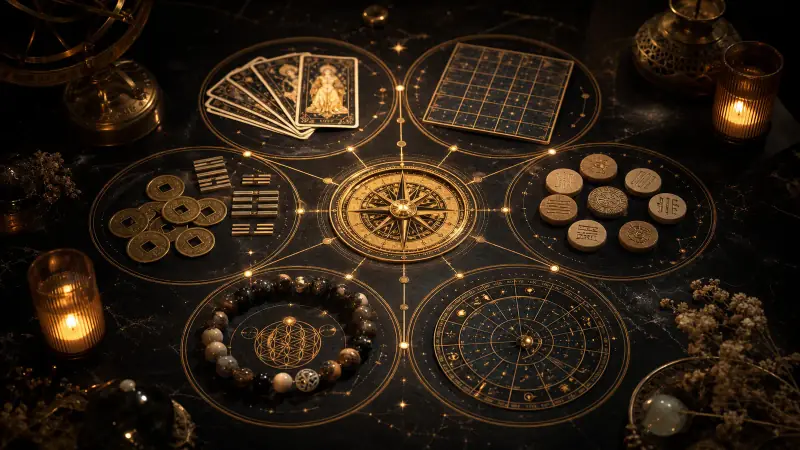
This article will deeply compare six major mainstream divination tools.——Tarot cards、Zi Wei Dou Shu astrology、Bazi fortune-telling、Numerology、I Ching (Book of Changes)、Astrology chart,From principles、Feature、Applicable scenarios and other aspects,Helps you find the path in life that resonates most with you.Navigation。
One、Tarot cards:A beacon of wisdom for Western intuitive divination.
What is Tarot??
Tarot cards are a spiritual exploration tool originating from the West.Possess,By 78 CardComposition,Divided into Major Arcana.(Major Arcana,22 Card (measure word))And Minor Arcana(Minor Arcana,56 Card (measure word))。Each card has unique symbolic patterns and profound meanings.Card meanings,Often used for self-reflection.、Introspection and spiritual awareness.。
The core principles of Tarot cards.
Tarot cards are not a tool for directly predicting the future.,Rather, through symbolic patterns and card spreads.,Helps users interpret.Current energy flow and potential outcomes.。It reminds us,The future is not fixed.,Rather, it emerges based on existing conditions and inner potential.All sorts of possibilities that emerge.。
The reason why Tarot cards can access the querent's subconscious.,Because it uses pictorial cards.,Provides a「Psychological projection」Medium。As professional Tarot readers say.:Tarot cards are just a mirror.,Reflects the deep-seated needs and anxieties in your subconscious.,Allows you to see things from another perspective.,Closer to one's inner self.。
The unique advantages of Tarot cards.
- Strong immediacy:No birth time needed.,You can always start a conversation with yourself.
- Problem-oriented:For specific doubts,Provides concrete directions for thought.
- Highly interactive:The act of drawing cards itself is a form of meditation and self-reflection.Awareness
- Flexible and versatile:Different card spreads can be chosen based on the question.,Close to current needs
Questions suitable for exploration with Tarot cards.
Tarot cards are particularly suitable for addressing the following types of questions.:
- Emotional confusion:What thoughts might the other person have in this relationship??How can things develop next??
- Career choices:What is the significance of accepting this job for me at this stage?Meaning?What are the conditions for starting a business now??
- Interpersonal interaction:What perspectives can improve my relationship with my family??
- Short-term context:What might be the energetic themes for the next three months??
- Decision reference:Face A Or B Two options,Which one is closer to my inner desires??
Reminders when using Tarot cards.
- When feeling down or emotionally unstable.,Not suitable for drawing cards.
- Questions should be specific、Clarity,And provides directions for exploration.
- Avoid touching on others' privacy or heavy topics like life and death.Issue
- It is not recommended to repeatedly ask the same question in a short period.
Two、Zi Wei Dou Shu astrology:The precise interpretation of Eastern astrological charts.
What is Zi Wei Dou Shu (Purple Star Astrology)??
Zi Wei Dou Shu (Purple Star Astrology) is a traditional Chinese astrological system.Neo-Confucianism,Is considered to interpret an individual's life journey.、A precise tool for understanding personality traits and life trends.。It uses ancient astronomy.、Yin-Yang and Five Elements、Based on theories such as Heavenly Stems and Earthly Branches.,Legend has it that it was created by Chen Tuan, a Daoist alchemist of the Five Dynasties.(872 Year—989 Year)Created by stargazing,Was revered as in ancient times.「Art of governance」。
With the relocation of the Nationalist government to Taiwan.,Zi Wei Dou Shu (Purple Star Astrology) has a very complete lineage in Taiwan.,Currently, its popularity and acceptance significantly surpass Bazi (Four Pillars of Destiny).,Almost as easy to remember and talk about as horoscopes.。
The core principles of Zi Wei Dou Shu (Purple Star Astrology).
Zi Wei Dou Shu usesThe fourteen main stars of the North and South Dippers.,Distributed among the twelve palaces.,Arranged and combined into sixty star systems.、One hundred and forty-four basic life charts.。Charting requires a complete birth time.(Year、Month、Day、Time),Otherwise, a complete astrological chart cannot be constructed.。
The twelve houses are:Life Palace、Siblings Palace、Spouse Palace、Children Palace、Wealth Palace、Sickness Palace、Travel Palace、Friends Palace、Career Palace、Property Palace、Fortune Palace、Parents Palace。Each palace reflects different aspects of life.。
The unique advantages of Zi Wei Dou Shu (Purple Star Astrology).
- Rich in information:Very detailed chart,Covers all aspects of life.
- Detailed interpretation:Can provide a framework,Allows us to observe annual cycles more clearly.、Monthly Luck Cycle,Even daily themes
- Clear structure:Suitable for those who want to quickly understand themselves.、People who want to clarify their current life focus.
- Moderate learning curve:Easier to get started with and understand than Bazi (Four Pillars of Destiny).
Questions suitable for exploration with Zi Wei Dou Shu (Purple Star Astrology).
- Life orientation:Where might my life's main focus and talents lie??
- Career development:What kind of work is suitable??Entrepreneurship and employment,Which path resonates more with my energy??
- Emotional relationships:When might I encounter a profound relationship?Relation?What are the noteworthy characteristics in the relationship??
- Money and resources:What are my financial tendencies??What methods are suitable for me to manage resources??
- Annual theme:What themes are emerging in my life this year??
Three、Bazi fortune-telling:The precise interpretation of Heavenly Stems and Earthly Branches.
What is Bazi (Four Pillars of Destiny)??
Bazi astrology,Also known as Four Pillars of Destiny、Zi Ping method,A system that deduces life's journey from one's birth time.Relation。Since Xu Ziping established it during the Song Dynasty.、Day、Month、After the method of Four Pillars of Destiny.,Also known as「Zi Ping Bazi」。
「Four Pillars of Destiny」Refers to the time of a person's birth.——Year、Month、Day、Time。Each pillar combines one Heavenly Stem and one Earthly Branch.Indicate,Eight characters in four pillars,So it is called「Bazi」。
The core principles of Bazi (Four Pillars of Destiny).
In Chinese culture,Ancients usedWood、Fire、Earth、Metal、WaterThe basic elements that constitute heaven, earth, and the universe.,The Five Elements mutually generate and overcome each other.。The views and propositions of Bazi (Four Pillars of Destiny) theory.「The living have feelings,Conquerors are righteous」,Seeking a balance and harmony between creation and destruction.。
Heavenly StemsTotal of 10 Unit:Jia (Yang Wood)、Yi (Yin Wood)、Bing (Yang Fire)、Ding (Yin Fire)、Wu (Yang Earth)、Ji (Yin Earth)、Geng (Yang Metal)、Xin (Yin Metal)、Ren (Yang Water)、Gui (Yin Water)。
Earthly BranchesTotal of 12 Unit:Zi (Rat)、Chou (Ox)、Yin (Tiger)、Mao (Rabbit)、Chen (Dragon)、Si (Snake)、Wu (Horse)、Wei (Goat)、Shen (Monkey)、You (Rooster)、Xu (Dog)、Hai (Pig)。
In Bazi (Four Pillars of Destiny), the Day Master is the center.,Called「True Self」Or「Day Master」。The Day Master is the Heavenly Stem of the birth day.,Is the core positioning of the entire astrological chart.。
The unique advantages of Bazi (Four Pillars of Destiny).
- Complete theory:Developed over thousands of years,Mature system
- High level of detail:Can approach from different periods.,To understand life's rhythm more finely.
- Life cycle perspective:Suitable for those who want to experience the ups and downs of fortune.、People who want to be aware of their major life cycles and annual fortunes.
- Rich in classics:Have《Yuan Hai Zi Ping (Abyss of Zi Ping)》《San Ming Tong Hui (Three Fates Comprehensive)》《Di Tian Sui (Heavenly Marrow)》And other classic works
Questions Better Suited for Ba Zi Exploration
- Innate tendencies: What might my birth chart suggest about my natural strengths and challenges?
- Ten-year life phases: What rhythms and themes might unfold over the coming decade?
- Balancing the five elements: Which elements appear less pronounced in my chart, and how might I cultivate greater harmony?
- Relationship compatibility: How might my chart and a partner’s chart interact in terms of complementary energies?
- Career and resource flow: When could be a more auspicious time to launch a venture or consider an investment, based on the cycles in my chart?
How Ba Zi and Zi Wei Compare
| Comparison item | Ba Zi (Four Pillars) | Zi Wei (Purple Star) |
|---|---|---|
| Learning curve | Steeper | Moderate |
| Depth of information | Concise and penetrating | Rich and detailed |
| Common usage | Less widespread | More popular |
| Approach to exploring patterns | Major cycles and annual influences | Stars and house placements |
| Who may find it appealing | Those who enjoy deeper study | General seekers |
As one authority on Chinese metaphysics notes: Zi Wei is well suited for those who wish to quickly understand themselves and explore possible life directions; Ba Zi may appeal to those interested in observing the rhythm of cycles and the flow of life phases. Though their approaches differ, they can complement each other.
4. Life Path Number: Unlocking the Mystery of Numerical Energy
What Is a Life Path Number?
The Life Path Number, also called numerology, traces back to the ancient Greek philosopher and mathematician Pythagoras. Its core idea is that a person’s birth date can be reduced to a single digit (or a master number) that reflects fundamental traits, gifts, and the general thrust of one’s life path.
How to Calculate Your Life Path Number
Add every digit of the birth date together. If the result is a two-digit number, add those two digits. Repeat until you arrive at a single digit, unless the result is 11, 22, or 33.
Example: Birth date June 20, 1977
Calculation: 1+9+7+7+0+6+2+0 = 32, then 3+2 = 5
The Life Path Number is 5
The numbers 11, 22, and 33 are considered Master Numbers. They are not reduced further and carry a deeper resonance, hinting at greater potential for accomplishment as well as more intense challenges.
Core Traits of Numbers 1–9
| Number | Core theme | Strengths |
|---|---|---|
| 1 | Leader | Confidence, independence, strong drive |
| 2 | Harmonizer | Gentleness, cooperation, diplomacy |
| 3 | Communicator | Creativity, optimism, social ease |
| 4 | Builder | Stability, practicality, perseverance |
| 5 | Adventurer | Freedom, curiosity, adaptability |
| 6 | Caregiver | Warmth, nurturing, family focus |
| 7 | Thinker | Wisdom, intuition, spiritual seeking |
| 8 | Achiever | Leadership, business acumen, organizational ability |
| 9 | Humanitarian | Compassion, wisdom, empathy |
Unique Strengths of Life Path Number
- Simple calculation: only the birth date is needed
- Easy to grasp: interpretations tend to be straightforward
- Self-discovery: quickly highlights core personality themes
- Interpersonal insight: can offer perspective on how you relate to others
Limitations of Life Path Number
The advantage of the Life Path Number is its simplicity, but as a tool for exploring one’s life pattern it can be quite general. It rarely offers the depth needed for a nuanced personal exploration, so many people use it as a supplementary lens alongside other reflective methods.
5. I Ching: Ancient Wisdom, the First of the Classics
What Is the I Ching?
The I Ching (Book of Changes) is often considered China’s oldest text. Tradition says the sage Fu Xi drew the eight trigrams, and King Wen of Zhou expanded them into the 64 hexagrams while under house arrest. Early uses centered on divination. The I Ching is revered by Confucianism as the “first among the classics” and a “source of culture” — a crystallization of Chinese wisdom.
The word Yi carries three meanings: simplicity, change, and the unchanging — a simple symbolic system that describes the eternal principles underlying a universe of constant change.
Core Principle of the I Ching
“Tai Ji produces the Two Modes, the Two Modes produce the Four Images, the Four Images produce the Eight Trigrams, and the Eight Trigrams give rise to the 64 hexagrams.”
The 64 hexagrams are recorded in the I Ching. Each hexagram is formed by combining two trigrams, one above the other, and each hexagram contains six lines (yao). Through these combinations, the I Ching reflects 64 archetypal situations, moods, phenomena, life principles, and the operating laws of nature.
I Ching Consultation Methods
Two common approaches to consulting the I Ching:
- Coin method: Toss three identical coins six times. Each toss yields one line (yao); six tosses build the full hexagram.
- Yarrow stalk method: Traditionally uses fifty yarrow stalks and involves a more elaborate procedure.
Unique Strengths of the I Ching
- Philosophical depth: It is not merely a divination tool but a repository of life wisdom
- Broad application: Can be used to reflect on career, relationships, decisions, and more
- Long history: Its insights have been tested across thousands of years
- Cultural foundation: It lies at the root of Confucian, Daoist, and other schools of thought
Questions the I Ching Can Help You Reflect On
The I Ching is especially well suited for pondering significant life choices and directional questions, such as:
- Career decisions: Is this a moment for a change? What might I consider about this investment?
- Life direction: Where am I being called to develop next?
- Timing: Is now a favorable time to act?
- Overcoming obstacles: How might I approach a creative breakthrough when I feel stuck?
As an old saying goes: after studying the I Ching, one may find less need to have one’s fortune told — because the I Ching teaches principles of living and harmonizing, rather than simplistic predictions of good or bad fortune.
6. The Astrological Birth Chart: A Cosmic Map of Planetary Movements
What Is an Astrological Birth Chart?
A birth chart (also called a natal chart or horoscope) is essentially a map of the sky at the exact moment and place of a person’s birth, showing the positions of celestial bodies.
A birth chart usually includes signs, houses, planets, and the aspects between them. Astrological reflections are largely drawn from the birth chart — offering perspectives on personality, resources, relationships, career, well-being, and the interplay of innate dispositions with life experiences.
The Core Elements of a Birth Chart
To study astrology, you’ll want to understand four essential pillars: planets, signs, houses, and aspects.
You can picture a birth chart as a theater:
- Planets are the actors (Sun, Moon, Mercury, Venus, Mars, Jupiter, Saturn, Uranus, Neptune, Pluto)
- Signs describe how the actors express themselves (their costumes and the attitude they bring)
- Houses are the stage settings, the backdrop where they appear and become most active
Key Astrological Placements Explained
| Placement | Meaning |
|---|---|
| Sun sign | Core self, fundamental personality |
| Moon sign | Emotions, inner needs |
| Rising sign | Outer image, first impression you give |
| Mercury sign | Thinking style, communication manner |
| Venus sign | Approach to love, aesthetic taste |
| Mars sign | Drive, how desires are expressed |
Unique Strengths of the Astrological Birth Chart
- Comprehensiveness: Can offer insights into multiple life areas such as personality, relationships, and career
- High precision: The more accurate your birth time, the more detailed and personally resonant the chart can be
- Timing insights: Provides a framework for observing transits, progressions, and life rhythms
- Wide accessibility: Generally easy for people to connect with and understand
Cautions When Using the Birth Chart
- One single sign can never fully capture the entirety of a person’s character
- The Sun sign—the one we talk about most often—reflects only a part of the personality
- A more complete picture emerges when you combine the Moon sign, rising sign, and the rest of the chart
- Different birth times produce different house cusps (roughly every 4 minutes, the 12-house axis shifts about 1 degree)
7. Quick-Reference Table: When to Use Each Divination Tool
| Tool | Information needed | Best suited for | Time frame | Learning curve | Basis of insight |
|---|---|---|---|---|---|
| Tarot | Current question | Love, decisions, short-term trends | 3–6 months | Moderate | Intuitive connection |
| Zi Wei Dou Shu | Birth date and time | Life direction, career, marriage | Lifetime | Moderate | Star positions and houses |
| BaZi (Four Pillars of Destiny) | Birth date and time | Major life cycles, five‑element harmony | Lifetime | Higher | Stems, branches, five elements |
| Life Number (Numerology) | Birth date | Personality traits, interpersonal patterns | Lifetime | Simple | Number energy |
| I Ching | Current question | Major decisions, life direction | Current to mid‑term | Higher | Hexagrams and line texts |
| Birth Chart (Astrology) | Birth date, time, and place | Personality, transits, relationship dynamics | Lifetime | Moderate | Planetary movements |
8. How to Choose the Right Tool for You
Choose by question type
Looking for insight into a current dilemma or a short-term decision?
→ Tarot or I Ching can be especially helpful.
Interested in life direction and the larger arc of your path?
→ Zi Wei Dou Shu or BaZi offer reflective frameworks.
Want a quick glimpse into your personality traits?
→ Life Number or an astrology birth chart are accessible starting points.
Choose by personal preference
Prefer intuitive, interactive divination?
→ Tarot may feel most at home.
Like systematic, logic‑driven analysis?
→ BaZi or Zi Wei Dou Shu could be a good match.
Enjoy simple, fast, easy‑to‑use tools?
→ Life Number or astrology.
Want to dive deep into Eastern philosophical wisdom?
→ The I Ching is an excellent choice.
Expert advice
If you are just getting started, consider beginning with a more structured system. Both BaZi and Zi Wei Dou Shu have clear chart‑casting rules and can be learned systematically. Resist the urge to study several methods at once—deep focus on one system to build a solid foundation is most important.
Also, when seeking a professional reader, pay attention to their area of specialty. It is not that cross‑training is impossible; it is about the depth of expertise.
9. The Right Mindset for Engaging with Divination Tools
No matter which tool you choose, hold these attitudes in mind:
- Divination is reference, not fixed destiny — the power to make choices always remains in your own hands.
- Aim to navigate life’s ebbs and flows, not to surrender to fatalism — understanding energetic patterns helps you prepare and adjust.
- A tool for self‑discovery — these systems help illuminate your strengths and personal challenges.
- Respect professional guidance — for complex or deeply personal matters, consider consulting a qualified practitioner.
Conclusion: Begin Your Divination Journey
Every divination tool brings its own value and ideal context. The point is not “which one is the most accurate,” but rather “which one best meets your current needs.”
If you are standing at a crossroads and want timely guidance and reflection, Tarot is a wonderful companion. It doesn’t require detailed birth data—just an open heart and a clear question—to help you spot blind spots, untangle your thoughts, and find your direction.