Planets and Aspects: The Deep Codes of a Birth Chart
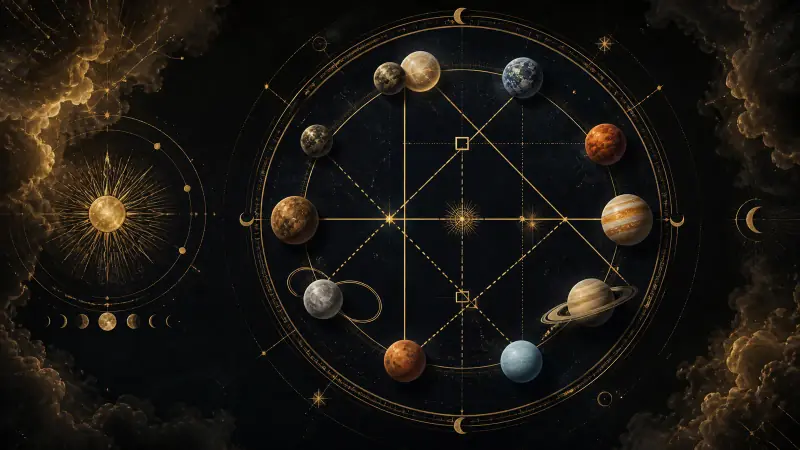
If zodiac signs are the “colors” of your personality, then planets are the “actors” and aspects are the “script” between them. To truly read a birth chart, understanding planets and aspects is essential.
This advanced guide will take you deep into the energy of each planet and how they interact through aspects.
The Ten Planets in Detail
Personal Planets
Personal planets move relatively quickly and more directly color your daily personality and behavior.
☉ The Sun: Your Core Self
- Orbital cycle: 1 year
- Represents: Self-consciousness, willpower, vitality
- Influence by zodiac sign: shapes your core personality and sense of purpose
The Sun is often called your “true self,” a reflection of the person you aspire to become in this lifetime. A prominent Sun placement can point to strong leadership abilities and self-confidence, while a more challenged Sun might suggest a longer journey toward finding your authentic self.
☽ The Moon: Your Emotional World
- Orbital cycle: approx. 28 days
- Represents: Emotions, needs, subconscious, habits
- Influence by zodiac sign: shapes how you express and process feelings
The Moon symbolizes your childhood memories, your need for security, and the self that emerges when you take off your masks. Its placement also offers insight into your relationships with feminine figures, especially your mother, and how you nurture yourself and others.
☿ Mercury: Your Way of Thinking
- Orbital cycle: approx. 88 days
- Represents: Communication, thought, learning, travel
- Influence by zodiac sign: shapes your thinking and communication style
Mercury shows your intellectual rhythm—whether you tend to leap with intuition or analyze step by step. During Mercury retrograde periods, many people feel that communication and transportation can seem a bit muddled; it’s often seen as a time better suited for review than for launching new initiatives.
♀ Venus: Your Love and Beauty
- Orbital cycle: approx. 225 days
- Represents: Love, aesthetics, money, values
- Influence by zodiac sign: shapes how you give and receive love
Regardless of gender, Venus illuminates your relationship with pleasure, beauty, and personal values. It reflects what attracts you and how you express affection, as well as your approach to material comfort and harmony.
♂ Mars: Your Action and Drive
- Orbital cycle: approx. 2 years
- Represents: Action, desire, competition, anger
- Influence by zodiac sign: shapes how you pursue goals and assert yourself
Mars is like your inner warrior—it describes how you go after what you want, how you handle conflict, and how you channel passion. A strong Mars placement may indicate an enterprising, assertive nature, though at times it can lean toward impatience.
Social Planets
Social planets influence how you develop and find your place within society.
♃ Jupiter: Your Luck and Expansion
- Orbital cycle: approx. 12 years
- Represents: Luck, expansion, faith, higher education
- Influence by house: can indicate where you might encounter opportunities for growth
Traditionally known as the “greater benefic,” Jupiter’s house position often highlights areas of life where things may flow more easily. It also relates to your belief systems, search for meaning, and life philosophy.
♄ Saturn: Your Lessons and Maturity
- Orbital cycle: approx. 29 years
- Represents: Responsibility, limitation, fear, maturity
- Influence by house: can point to major life lessons and where you build character
Saturn acts like a strict teacher. The house it occupies often asks for extra effort, but meeting these challenges can bring deep, lasting accomplishment. The Saturn return around age 29 is widely viewed as a time of profound personal growth and realignment.
Generational Planets
Generational planets move slowly, shaping the collective consciousness of entire generations.
| Planet | Cycle | Represents | Generational Influence |
|---|---|---|---|
| ⛢ Uranus | 84 years | Revolution, innovation, freedom | How a generation breaks from tradition |
| ♆ Neptune | 165 years | Dreams, spirituality, illusion | Collective ideals and disillusions |
| ♇ Pluto | 248 years | Transformation, power, rebirth | Deep, systemic societal change |
Understanding Retrograde Periods
When a planet appears to move backward from our vantage point, it is called retrograde. Many astrologers see these periods as times when the areas ruled by that planet invite reflection, review, or a slower pace.
Common Retrograde Influences
| Planet | Retrograde frequency | Traditional observations | Common guidance |
|---|---|---|---|
| Mercury | about 3x per year, ~3 weeks each | Miscommunication, tech glitches, travel delays | Tend toward reviewing and revising; major decisions can wait |
| Venus | every 18 months, ~40 days | Reflection on love and values | Not the best time to start a new relationship; ideal for reassessing what truly matters |
| Mars | about every 2 years, ~2 months | Lower drive, pent-up frustration | Good time to strategize instead of pushing ahead impulsively |
| Jupiter | once a year, ~4 months | Slower growth, beliefs questioned | An opportunity for inward reflection and refining your vision |
| Saturn | once a year, ~4.5 months | Feeling less burdened, life themes resurface | A call to revisit long-term goals and structures |
The Five Major Aspects
Aspects are the angular relationships between planets, revealing how their energies blend or clash.
☌ Conjunction (0°)
Keywords: merging, intensification
Two planets occupy the same degree, fusing their energies completely. This is the strongest aspect. It can bring a powerful focal point of energy, though sometimes at the cost of objectivity.
For example: Sun conjunct Venus → often suggests a charming nature and a strong appreciation for beauty and harmony.
⚹ Sextile (60°)
Keywords: opportunity, cooperation
Two planets form a gentle, cooperative link. This aspect brings opportunities and ease, but it often requires active effort to fully realize its gifts.
For example: Moon sextile Mercury → can indicate emotional and intellectual coordination, making it easier to articulate feelings.
□ Square (90°)
Keywords: challenge, growth
Two planets stand in a tense relationship, generating conflict and friction. Squares are often seen as growth catalysts—rocky but ultimately transformative. It’s the “difficult aspect,” yet overcoming its hurdles tends to yield the most meaningful personal development.
For example: Mars square Saturn → may feel like ambition meets resistance, but it encourages learning to channel strength responsibly.
△ Trine (120°)
Keywords: harmony, talent
Two planets relate in a naturally flowing, supportive way. This aspect points to innate talents and ease in certain areas. It’s considered a “lucky aspect,” though its comfort can sometimes lead to complacency unless consciously challenged.
For example: Venus trine Jupiter → may indicate a natural sense of ease in matters of love and abundance.
☍ Opposition (180°)
Keywords: Opposition, Awareness
Two planets face each other, creating a push-pull tension that calls for balance. This aspect fosters awareness and helps you see the other side of a situation.
Example: Sun opposite Moon → Tension between inner needs and outer pursuits, requiring integration
Aspect Interpretation Tips
1. Consider the Planets’ Nature
First understand what each planet represents, then examine the aspect they form.
2. Check the Orb
The tighter the aspect (the closer the angle to the exact degree), the stronger its influence.
| Aspect | Exact Orb |
|---|---|
| Conjunction / Opposition | ±8° |
| Trine / Square | ±6° |
| Sextile | ±4° |
3. Assess Planetary Strength
Aspects involving the Sun and Moon carry the most weight, followed by those of the personal planets.
Special Aspect Patterns
T-Square
Three planets form one square and two oppositions, creating tremendous tension and drive. This configuration often points to a major life challenge, but also a source of achievement.
Grand Trine
Three planets form three trines, shaping an equilateral triangle. It represents natural talent and ease, though it’s worth being mindful not to become complacent.
Grand Cross
Four planets create four squares and two oppositions. This is one of the most challenging patterns, yet it brings substantial growth potential.
Practical Application
Know Yourself
Identify the most important aspects in your birth chart to understand your strengths and life lessons.
Seize the Moment
Pay attention to the aspects transiting planets make to your natal chart—they can influence different areas of life.
Dive Deeper
Use our birth chart analysis tool for a personalized reading!
Further Reading
Final Thoughts
Planets and aspects are advanced topics in chart interpretation that reward time, study, and practice. Remember, a birth chart reflects potentials and tendencies—the life you live is ultimately shaped by you.
May the stars light your journey of exploration✨